


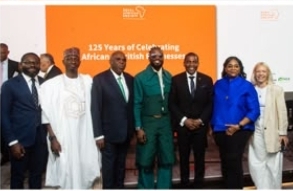
The President/CEO of Funab Group of Companies Limited, Alhaji Ibrahim Mohammed Ajia, Ph.D is decked in white Babariga in a group photograph with the prominent figures at the London event.
By Abdulrahman Aliagan with Agency
The President and Chief Executive Officer of Funab Group of Companies Limited, Alhaji (Dr.) Ibrahim Mohammed Ajia, has joined world leaders, diplomats, business executives and development experts at the Royal African Society’s (RAS) 125th Anniversary Flagship Business Event held at the London Stock Exchange, with participants calling for stronger partnerships, increased investment and a fundamental shift in how Africa’s economic development is approached.
The high-level gathering brought together policymakers, investors, captains of industry, development finance institutions and other stakeholders to deliberate on Africa’s economic future, with discussions focusing on how the continent can strengthen its global leadership, attract sustainable investment, accelerate industrialisation and build prosperous economies over the next 125 years.
The event commenced with registration and networking before participants were formally welcomed by the Director and Chief Executive Officer of the Royal African Society, Stella Okuzu.
The Society’s Patron and President of Afreximbank, Prof. Benedict Oramah, delivered welcome remarks, while Tiffany Sadler, Head of Southern and Central Africa and Special Envoy to the Great Lakes at the UK’s Foreign, Commonwealth and Development Office, presented the opening remarks.
The Prime Minister of St. Kitts and Nevis, Dr. Terrance Drew, delivered the keynote address, where he advocated stronger cooperation between Africa and the Caribbean and emphasised the need for greater international collaboration in addressing the development challenges confronting both regions.
Reflecting on the significance of the anniversary, Prof. Arunma Oteh, Chairperson of the Royal African Society, said the 125-year milestone provided an opportunity not only to celebrate the organisation’s history but also to examine contemporary challenges that have long been associated with Africa’s relationship with the wider world.
According to her, some of the issues confronting Africa today were already being discussed by Mary Kingsley, a prominent advocate for Africa, in the late 1890s.
“We are celebrating 125 years of being in existence, but more importantly, some of the issues that we’re dealing with today are issues that Mary Kingsley, who has always been a champion of Africa, was talking about in the late 1890s,” Oteh said.
She noted that the organisation was founded in Mary Kingsley’s memory by Africans and people in the United Kingdom who understood Africa’s significance to the rest of the world.
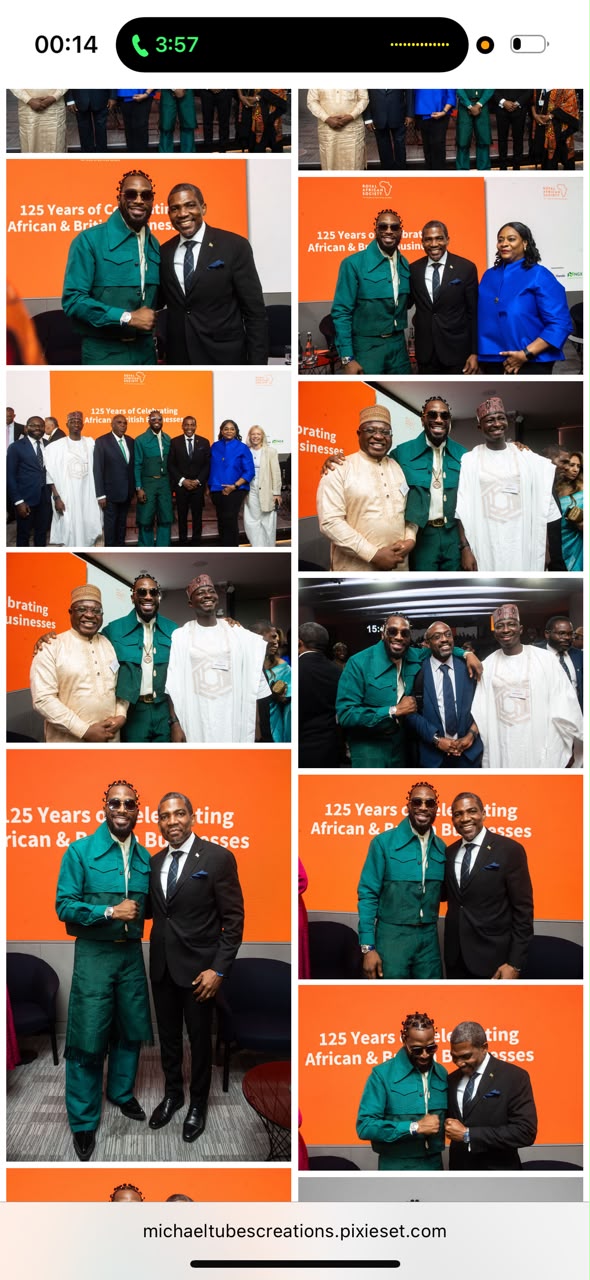
Faces of the world leaders, diplomats, business executives and development experts at the Royal African Society’s (RAS) 125th Anniversary Flagship Business Event held at the London Stock Exchange
A major highlight of the event was a high-level panel on “Positioning Africa for Global Leadership,” featuring Colonel Christian Katsande, Dean of the African Heads of Mission in the United Kingdom; His Royal Highness Khalifa Muhammad Sanusi II, Emir of Kano; H.E. Ben Ainslie, Acting Trade Commissioner for Africa; and Prof. Arunma Oteh, Chairperson of the Royal African Society. The session was moderated by international journalist Femi Oke.
The discussions centred on Africa’s capacity to assume a more influential role in global affairs, with participants emphasising the importance of partnerships built on mutual respect, trade, investment and shared prosperity.
Prof. Benedict Oramah, President of Afreximbank and Patron of the Royal African Society, said the founding vision of the organisation was rooted in the promotion of mutual respect, commerce, cooperation and collaboration between Africa and Britain, rather than a relationship based primarily on aid.
Oramah said Africa’s development must be approached with a proper understanding of its culture, governance systems and capacity to thrive through mutually beneficial commercial relationships.
“What it aspired to, from the aspirations of Mary Kingsley, the founder, was to be a platform to promote mutual respect, commerce, not aid, cooperation and collaboration with Africa that understands that Africa has its culture, has its own way of governance, and that Africa can thrive on commerce, fair commerce with Britain,” he said.
The event also featured extensive discussions on development finance, with Samaila Zubairu, President and Chief Executive Officer of Africa Finance Corporation (AFC), and Leslie Maasdorp, Chief Executive Officer of British International Investment (BII), examining innovative financing models capable of supporting Africa’s industrialisation, infrastructure development and long-term economic transformation.
Zubairu called for a deliberate focus on the future Africa wants to build, stressing the need for intentional economic planning that would guarantee dignity and prosperity for the continent’s people.
“I want us to focus on the future that we have to build,” he said.
He added that the anniversary event provided a platform to confront Africa’s key development challenges and agree on practical pathways towards creating a more prosperous future.
“I think there is a platform here for us to talk about the key challenges we have and to agree a path on how we can intentionally build a future for Africans to have dignity and prosperity. We have to change the way our economies are structured, and we need to do that by intentionally planning for prosperity,” Zubairu said.
Participants also explored the future of global capital markets during a session featuring Alhaji (Dr.) Umaru Kwairanga, Chairman of Nigerian Exchange Group Plc (NGX); Sunil Benimadhu, Chief Executive Officer of the Stock Exchange of Mauritius; Nandini Sukumar, Chief Executive Officer of the World Federation of Exchanges; and Tom Attenborough of the London Stock Exchange.
A separate session on private-sector financing brought together senior executives from Standard Chartered, First Bank UK and United Bank for Africa (UK) Limited, who discussed innovative financing mechanisms for expanding economic opportunities and supporting sustainable economic growth across Africa.
The afternoon sessions focused on strategic sectors considered critical to Africa’s long-term transformation, including mining, oil and gas, technology, infrastructure, healthcare and the creative economy.
Speakers at the sessions included Olugbenga Agboola, Founder and CEO of Flutterwave; Dr. Emeka Emuwa, Chairman of Africa Finance Corporation; Solomon Quaynor, Vice President of the African Development Bank; Nneka Onyeali-Ikpe, Group Managing Director/Chief Executive Officer of Fidelity Bank Plc; Dr. Githinji Gitahi, Group CEO of Amref Health Africa; Dr. Awele Elumelu; media entrepreneur Mo Abudu; actor and philanthropist Idris Elba; and technology investor Iyinoluwa Aboyeji.
Also speaking on the need to reposition Africa’s economic development agenda, Wale Tinubu stressed the importance of mobilising global capital to support primary development across the continent while strengthening technology cooperation.
He said Africa must move beyond an exclusive focus on economic growth to a broader development-oriented approach capable of improving the quality of life of its people.
“This is a focus on seeking primary development in Africa, using global capital towards doing that, merging the ideas regarding technology cooperation, and effectively changing our ethos from one of growth to one of development on the continent,” Tinubu said.
He added that the ideas emerging from the event resonated strongly with the private sector and expressed willingness to continue advancing the conversations around Africa’s development.
The participation of Alhaji (Dr.) Ibrahim Mohammed Ajia at the landmark event underscored the growing engagement of Nigerian business leaders in global conversations around investment, economic development, trade and international partnerships.
During the event, Ajia engaged with policymakers, development finance institutions, investors and business executives on opportunities to strengthen trade and investment relationships, promote sustainable economic growth and deepen collaboration between Africa and the global business community.
His participation also reflected the increasing role of African private-sector actors in shaping conversations around the continent’s economic future, particularly at a time when Africa continues to seek new models of financing, industrialisation, technology transfer and international cooperation.
The Royal African Society’s 125th Anniversary celebration concluded with a networking reception, providing participants with further opportunities to deepen relationships and explore partnerships aimed at advancing Africa’s development agenda.
The event ultimately reinforced a central message: that Africa’s future must be shaped by stronger partnerships, fair and mutually beneficial commerce, strategic deployment of global capital, technology cooperation and deliberate economic planning capable of delivering dignity, prosperity and sustainable development for the continent’s people.