


By Bayo Adewale
“ _Any contractor who collects mobilisation funds and fails to perform will face possible prosecution by anti-graft and law enforcement agencies.”_ Those were the strong words of the Minister of Works, Senator Engr. David Umahi, and a visit to the Abuja-Lokoja Highway suggests that the warning is being matched with visible action on the ground.
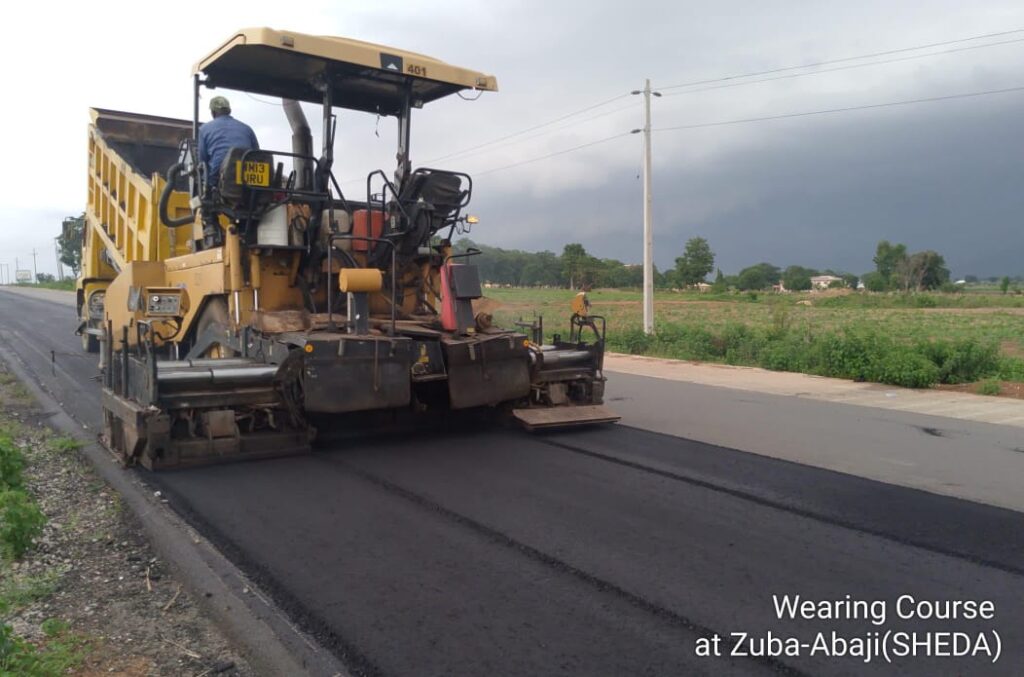
Our media crew visited the project site to see things for ourselves, what we met was different from the familiar picture of abandoned projects, idle equipment and broken promises. From Chainage 0+000 to 5+586, construction activities are ongoing, with workers and equipment steadily transforming sections of the highway that have suffered years of deterioration. The road is not yet completed, but there is visible evidence of work in progress.
The rehabilitation project, being undertaken by Truecrete Solution, covers both shoulders of the highway. The contractor has cleared sections of the road, removed the old surface dressing and excavated down to the subgrade level before proceeding with the various stages of pavement construction. Granular sub-base material has been laid up to approximately Chainage 5+490 on one side and 3+320 on the other, while rigid concrete pavement has progressed to about Chainage 4+480 and 1+195 respectively.
The quality of such work is just as important as the speed of construction. Road infrastructure ultimately has to withstand years of traffic, particularly on a busy corridor such as Abuja-Lokoja, this makes proper supervision critical, and the FCT Federal Controller of Works, Engr. Eze Justin Chukwuedozie, has maintained regular presence at the site, monitoring the various stages of construction and ensuring that the contractor works in line with approved specifications and quality requirements.
Since assuming office as Minister of Works, Engr David Umahi has consistently placed contractor performance and accountability at the centre of his approach to federal road projects. His position that contractors who collect mobilisation funds without deploying the necessary equipment, manpower and resources should face consequences has sent a clear message to the industry: public funds must translate into actual work. On a project such as the Abuja-Lokoja Highway, that principle is particularly important because the ultimate beneficiaries are millions of Nigerians who depend on the road.
The significance of this corridor goes beyond Abuja and Lokoja. It is an important economic link connecting communities, markets and businesses across different parts of the country. Agricultural produce, manufactured goods and passengers move through the route every day. When the highway deteriorates, motorists face longer journeys and higher vehicle maintenance costs, while businesses and transport operators bear increased logistics expenses. Its rehabilitation will restore an important artery of economic activity.
For President Bola Ahmed Tinubu, the project is also an opportunity to demonstrate that the Renewed Hope Agenda can be seen in physical infrastructure and not only discussed in speeches. But the real judgment will come when the work is completed and the road begins to withstand the daily pressure of traffic. Nigerians want infrastructure that will last, not projects that look impressive only at commissioning.
As the construction continues; the machines are working, the concrete is being laid and sections of the highway are gradually taking a new shape. There is still a distance to cover, but what we saw on the ground was enough to show that the Abuja-Lokoja Highway is moving from promises to physical delivery. For motorists who have waited years for a dependable road, that progress is, in itself, a reason for renewed hope.