


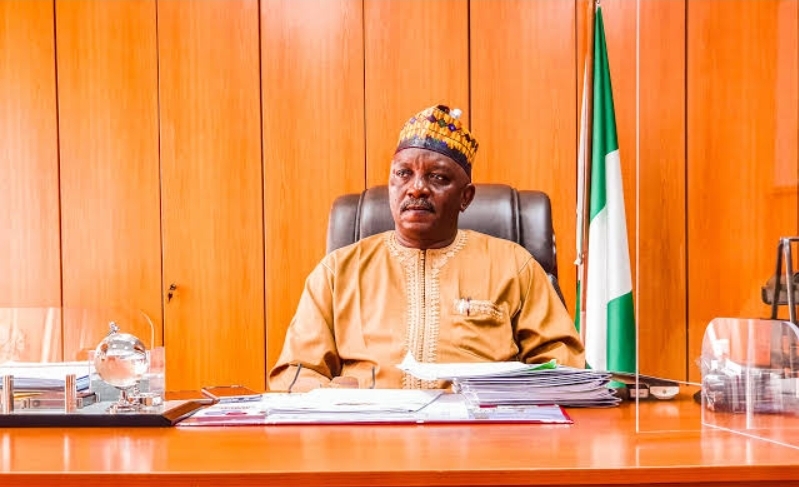
- asks Appeal Court to Quash Conviction
By Jamil Bala, Abuja
The Federal High Court in Abuja has struck out a motion filed by the Economic and Financial Crimes Commission (EFCC) seeking to forfeit properties allegedly linked to former Minister of Power, Engr. Saleh Mamman, who is asking the Court of Appeal to quash his conviction.
Justice James Omotosho struck out the EFCC’s motion — dated July 29, 2026, and filed under Section 20 of the EFCC Act 2004, Section 321 of the Administration of Criminal Justice Act 2015, and Section 6(6) of the 1999 Constitution — in charge No. FHC/ABJ/CR/273/2024, after prosecution counsel Abba. Mohammed formally withdrew it.
Mohammed told the court the decision to withdraw followed Mamman’s appeal against the entire judgment at the Court of Appeal, Abuja Division.
The motion had sought a consequential order to permanently forfeit to the Federal Government properties the EFCC allegedly traced to Mamman after his conviction and sentencing.
Defence counsel Femi Atteh did not oppose the withdrawal, and Justice Omotosho granted the application as prayed, striking out the motion in a brief ruling.
Mamman was convicted by Justice Omotosho on 12 counts tied to an alleged N33.8 billion fraud and handed consecutive prison terms totalling 75 years.
He has now approached the Court of Appeal, through a notice of appeal dated May 26, 2026 filed by his legal team led by Femi Atteh, SAN, asking the appellate court to quash the conviction and discharge and acquit him.
The appeal rests on 18 grounds. Central among them is a claim that his right to fair hearing was violated when judgment was delivered in his absence on May 7, 2026, despite an earlier adjournment to June 9, 2026 for judgment.
His team argues the date was abridged without any hearing notice served on him, that he never waived his right to be present, and that this breached Section 36 of the 1999 Constitution and Section 352(4) of the Administration of Criminal Justice Act 2015.
Other grounds raised include:
That the trial judge blocked his subpoenaed witness, Abdulkareem Ozi Ibrahim, (who was a Director Special Projects Accounts, in Accountant General of the Federation office),
from testifying in his defence, while improperly allowing the prosecution to reopen examination-in-chief of the same witness after it had already closed and the matter had been adjourned for cross-examination.
That the conviction relied substantially on uncorroborated accomplice evidence, and on counts 7–12 to which no plea was ever taken.
That the trial court wrongly found that funds from the Zungeru and Mambilla Hydroelectric power projects were diverted for his personal use, when the funds were domiciled with the Central Bank of Nigeria and controlled by the Office of the Accountant-General of the Federation, and he was neither an approving authority nor a signatory to the accounts.
That key findings rested on hearsay, disregarded documentary evidence, and amounted to speculation.
That the court improperly shifted the burden of proof onto him by holding that he failed to explain the source of funds used to purchase a property at No. 12 Lungi Street, Wuse II, Abuja.
That his extra-judicial statements were admitted without compliance with Sections 15 and 17 of the Administration of Criminal Justice Act 2015, including the absence of any audio-visual recording of the statements.
That the trial judge showed clear bias against him throughout the proceedings, occasioning a miscarriage of justice.
Family reaction
The conviction and 75-year sentence have drawn strong criticism from Mamman’s family and legal representatives, who have described elements of the trial as troubling.
They pointed to the accelerated delivery and service of the judgment as particularly concerning, alongside earlier defence complaints over disputed documentation, witness contradictions, disclosure issues and what they called weak evidentiary links concerns they say warrant further legal scrutiny.