


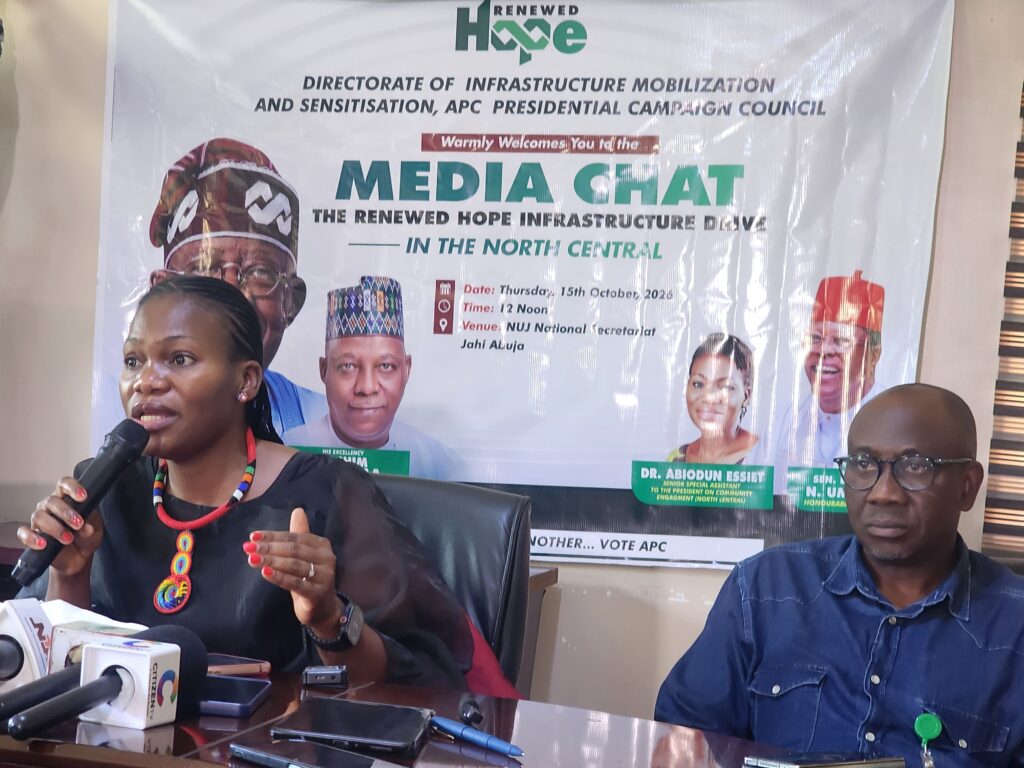
The Federal Government is implementing major road and bridge projects across Nigeria’s North-Central region as part of President Bola Ahmed Tinubu’s Renewed Hope Agenda. Dr. Abiodun Essiet said the investments are intended to improve connectivity, reduce travel times and support economic activity.
The projects include the 401-kilometre Lambata–Bida–Mokwa–Makera–Kontagora highway in Niger State, the Mararaba–Keffi expansion linking Nasarawa State with Abuja, the Lafia bypass, road interventions in Benue and Plateau states, and bridge works along the Abuja–Lokoja corridor.
They are at different stages of implementation, and their impact will depend on construction quality, funding continuity, effective supervision and long-term maintenance.
For residents, road conditions shape access to markets, hospitals, schools and commercial centres. Farmers in Niger and Benue states rely on road networks to transport produce, while commuters between Nasarawa and Abuja face congestion and delays. Traders and transport operators also contend with higher costs, vehicle damage and delivery disruptions when highways deteriorate.
At a media chat in Abuja, Dr Abiodun Essiet, Senior Special Assistant to the President on Community Engagement in the North-Central region, outlined infrastructure priorities across Benue, Kogi, Kwara, Nasarawa, Niger and Plateau states, as well as the Federal Capital Territory.
Essiet also discussed how communities could obtain information about federal projects, report implementation challenges and communicate concerns to relevant authorities.
The presentation placed transportation infrastructure at the centre of the government’s development agenda. Official records, however, distinguish between projects that have been completed, those under construction and others still at an earlier stage. For residents, that distinction matters: a new highway offers hope, but its benefits begin only when it becomes usable, safe and properly maintained.
Niger’s 401-Kilometre Highway Project
One of the region’s largest interventions is the reconstruction and dualisation of the Lambata–Bida–Mokwa–Makera–Kontagora road in Niger State.
The Federal Government flagged off the 401-kilometre project on October 14, 2026, at an estimated cost of ₦1.5 trillion. President Tinubu was represented at the ceremony in Bida by Niger State Governor Mohammed Umaru Bago.
The Federal Ministry of Information and National Orientation said the project would be financed through an arrangement involving the Dangote Group under the Federal Government’s tax-credit infrastructure financing model.
The highway is expected to improve connections between communities in Niger State and major routes linking different parts of the country. Given Niger’s importance to Nigeria’s agricultural economy, the corridor could facilitate the movement of grains and other farm produce while increasing capacity on sections used by heavy commercial vehicles.
The flag-off marks the beginning, not the completion, of the work. Its success will depend on construction standards, funding, adherence to schedules and effective oversight.
Because of the investment’s scale, transparency will be essential. Publishing milestones, schedules, expenditure details and independently verifiable progress reports would allow the public to assess implementation. Communities along the route will ultimately judge the project by whether it reduces journey times, improves market access and supports local businesses.
Mararaba–Keffi Expansion
The Mararaba–Keffi highway is a major commuter route linking Nasarawa State with the Federal Capital Territory.
The Federal Ministry of Works said the reconstruction and expansion covers 43.65 kilometres on one side, or 87.3 kilometres when both carriageways are counted.
The work comprises separate interventions. China Harbour Engineering Company Nigeria Limited is handling the Keffi-bound reconstruction and expansion, while JRB Construction Company is responsible for emergency rehabilitation of the Abuja-bound carriageway.
During an inspection in June 2026, the ministry said the minister expressed satisfaction with the quality and pace of work on the Keffi-bound section. It also said the Abuja-bound rehabilitation was scheduled for completion on March 1, 2028, with ancillary works including solar-powered streetlighting.
The two interventions should therefore not be presented as one completed project.
The expansion is intended to ease congestion and improve traffic flow, but construction has placed additional pressure on adjoining roads as motorists seek alternative routes. During the media chat, a journalist asked whether roads affected by diverted traffic would also be rehabilitated.
Essiet said responsibility for construction and maintenance is shared among federal, state and local authorities, depending on each road’s classification. Her response highlighted how improvements to a major federal highway can increase pressure on smaller roads not designed for heavy traffic.
Residents in Mararaba and neighbouring communities have raised concerns about damaged streets, congestion and pedestrian safety. Addressing them will require coordination among the Federal Government, the FCT Administration, the Nasarawa State Government and local authorities.
Abuja–Lokoja Corridor
The Abuja–Lokoja highway connects the Federal Capital Territory with Kogi State and links northern and southern Nigeria.
It carries passengers, agricultural produce, industrial goods and other commodities, so congestion, damaged sections and bridge problems can affect communities and businesses well beyond the immediate route.
Essiet said her office had received complaints about congestion along the corridor and forwarded them to relevant authorities.
The Federal Ministry of Works has identified bridge interventions along the Lokoja–Abuja route, including work on the Murtala Mohammed Bridge at Koton Karfe. In February 2026, the ministry also announced measures to address public complaints about road projects and their effects on residents.
These interventions show why the corridor must be managed as an interconnected system. Bridges, adjoining carriageways, drainage, traffic management and alternative routes all influence whether the route provides reliable journeys.
Benue Road Projects
In Benue State, road infrastructure is closely tied to agricultural production and the movement of goods between rural communities and major markets.
During the media chat, Essiet identified the Makurdi–Otukpo–Enugu corridor as important to regional connectivity. The Federal Ministry of Works has also reported ongoing work on the Makurdi–Ninth Mile–Enugu road project, intended to improve transportation between the North-Central and South-East regions.
In February 2026, the ministry said it had received a petition about excessive dust generated by construction activities along the corridor. It said directives had been issued to the contractor and other operators to address the problem.
The complaint illustrates the immediate effects of major construction, including dust, noise, traffic disruption and difficulty accessing homes and businesses. Improved roads could shorten journeys and ease the movement of farm produce, but residents also expect safer work sites, effective drainage and measures to limit environmental disruption.
Progress should therefore be assessed alongside the protection provided to surrounding communities.
Lafia Bypass
Nasarawa State’s proximity to Abuja and growing population have increased pressure on its road network.
One project highlighted during the media chat was the Lafia bypass, designed to divert through-traffic away from the state capital.
The Federal Ministry of Works described it as a 15.8-kilometre alternative route for travellers moving between Abuja, Makurdi and other destinations. The ministry has listed the project among those reported as completed or ready for commissioning.
A functioning bypass could reduce congestion in Lafia, improve travel times and ease pressure on densely populated areas. Its performance will depend on connecting roads, junctions, access points, signage and maintenance.
The media chat also addressed the Nasarawa–Toto–Abaji corridor and the Mararaba–Keffi highway, underscoring the importance of links between major roads, local communities, markets and public facilities. Without them, communities may not receive the full benefits of improved interstate routes.
Plateau Road Rehabilitation
In Plateau State, the Federal Government is implementing road rehabilitation and construction projects intended to improve access and regional connectivity.
One project discussed was the Babban Lamba–Sharam road. The Federal Ministry of Works announced the flag-off of Phase II of its rehabilitation on July 3, 2026, describing the intervention as part of the administration’s wider programme to improve connectivity, support economic growth and strengthen links between communities.
The road serves Plateau’s agricultural, commercial and tourism activities. Reliable access could also help residents reach health facilities, schools and administrative centres.
Essiet referred to bridge interventions and other road projects in the region, but the official record demonstrates why status must be reported precisely. A project whose second phase has been flagged off should not be described as fully completed without supporting evidence.
Residents need clear information on completed sections, ongoing work and expected completion dates.
Concrete Roads and Durability
The Federal Government’s growing use of concrete pavement on selected highways was another issue raised during the media chat.
The administration has said concrete roads could improve durability and reduce maintenance requirements. In October 2026, the Federal Ministry of Works reiterated its commitment to expanding concrete pavement on major highways, particularly routes carrying heavy commercial vehicles and high traffic volumes.
Long-term performance, however, depends on more than surface material. Engineering design, drainage, construction materials, traffic loads, supervision and maintenance also determine durability.
Concrete may be suitable in some conditions, but it does not remove the need for maintenance or independent quality assessments. For taxpayers, value for money should be judged over the road’s expected service life using engineering evidence, transparent contract information and the performance of completed roads.
Accountability and Community Engagement
The media chat also focused on how citizens can report abandoned projects, delays and poor-quality work.
Essiet said her office works with the Federal Ministry of Works and other agencies to receive community feedback and communicate complaints about infrastructure projects. She said residents and community volunteers could report problems, including congestion and other difficulties caused by construction.
Such engagement can reveal issues absent from formal progress reports, but an effective accountability system must do more than collect complaints. Residents should be able to identify the responsible agency, submit evidence, receive acknowledgement and learn what action was taken.
For major projects, the public should have access to the contract sum, contractor, commencement date, expected completion date and implementation status. Where complaints concern construction quality, technical inspections and engineering assessments should determine whether remedial work is required.
The government should also distinguish between referring a complaint and resolving it.
The Test of the Infrastructure Drive
The North-Central region has significant economic potential, supported by agriculture, mineral resources, expanding urban centres and its strategic position between different parts of Nigeria. Reliable transportation infrastructure is necessary to realise it.
Roads influence the cost of moving goods, access to essential services, investment decisions and communities’ participation in the wider economy.
The projects highlighted during Essiet’s media chat reflect the scale of the administration’s plans. Official records confirm major interventions, including the Lambata–Bida–Mokwa–Makera–Kontagora highway, the Mararaba–Keffi expansion, the Lafia bypass and the second phase of the Babban Lamba–Sharam rehabilitation. Yet their stages differ, and their value will depend on delivery.
For Niger residents, the priority is a dependable road along the Lambata–Kontagora corridor. For commuters between Nasarawa and Abuja, it is completion of the Mararaba–Keffi works and effective traffic management during construction. For communities in Benue and Plateau, it is safe, durable access to markets and essential services.
The Federal Government must convert capital spending into lasting public assets through transparent procurement, reliable funding, independent quality control, effective supervision and clear reporting. Federal, state and local authorities must also coordinate so that major highways are supported by functioning local roads and access infrastructure.
The media has a role in reporting verified progress while examining delays, defects and the experiences of affected communities.
Ultimately, the Renewed Hope infrastructure programme will not be measured by the number of projects announced or contracts awarded. Its success will be reflected in roads that remain usable, safer journeys, lower transport costs and better access to economic opportunities.