


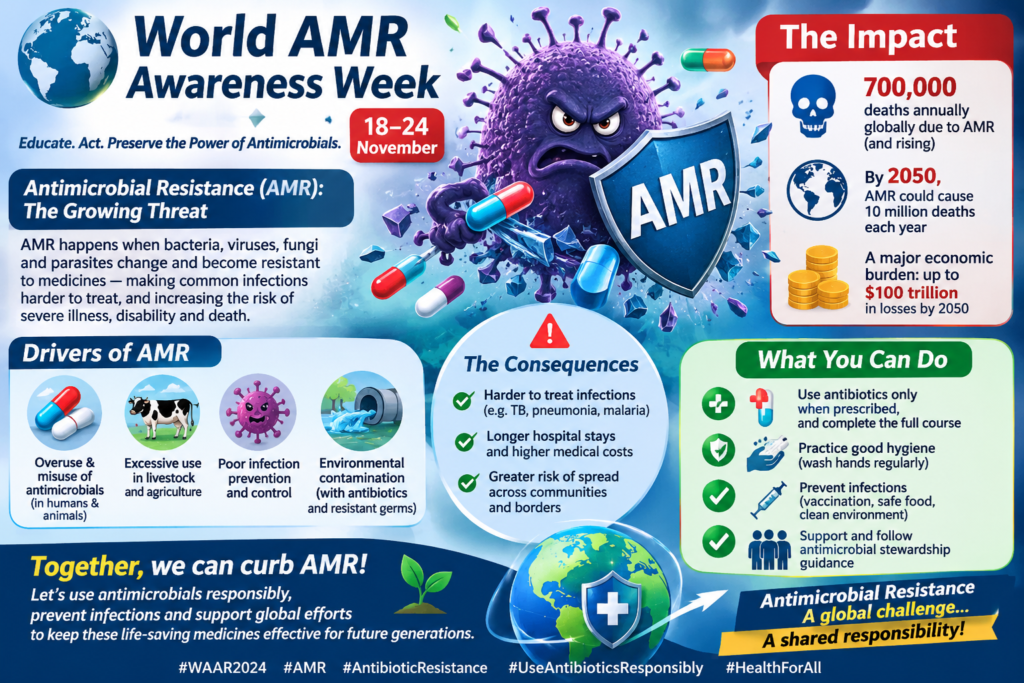
As antibiotics and other antimicrobial medicines lose their effectiveness against resistant microorganisms, the world faces a growing public-health crisis that could make once-treatable infections deadly, complicate surgery and cancer treatment, and place an enormous burden on already fragile healthcare systems.
By Abdulrahman Aliagan
The danger may not always announce itself with the dramatic symptoms associated with an epidemic. There may be no sudden explosion of cases, no immediate declaration of a national emergency and no visible warning that a familiar medicine has stopped working.
Instead, the crisis may begin quietly.
A patient develops an infection. A doctor prescribes a medicine that has worked for years. The patient takes it, but the infection persists. Another drug is introduced. The condition deteriorates. The patient is admitted to hospital, and treatment becomes more complicated, more expensive and less certain.
This is one of the troubling realities of antimicrobial resistance (AMR), a growing global health threat in which microorganisms develop the ability to survive medicines that were previously capable of killing them or stopping their growth.
The implications are enormous.
Medicines that once made bacterial infections manageable, helped patients recover from surgery, protected vulnerable newborns and supported the treatment of cancer patients could become less effective as resistance spreads.
The World Health Organization (WHO) identifies antimicrobial resistance as one of the major public-health threats confronting humanity. The problem affects not only antibiotics but also antiviral, antifungal and antiparasitic medicines.
The 2026 World AMR Awareness Week, observed from November 18 to 24, is therefore not simply another health-awareness campaign. It is a call to confront a threat that could undermine decades of medical progress.
Under the theme “One Health, One Action: Prevent AMR Now,” this year’s campaign emphasises that the health of humans, animals, plants and the environment is interconnected, and that the emergence and spread of resistant organisms cannot be tackled by the health sector alone.
What exactly is antimicrobial resistance?
Antimicrobial resistance occurs when microorganisms—including bacteria, viruses, fungi and parasites—develop the ability to survive or withstand medicines intended to eliminate them or control their growth.
It is important to understand that the human body does not become resistant to antibiotics.
Rather, the microorganisms causing infections develop resistance.
Bacteria, for instance, can evolve through genetic changes or acquire resistance genes from other bacteria. Some develop mechanisms that destroy medicines, prevent drugs from entering their cells, pump drugs out or alter the targets medicines are designed to attack.
As these organisms survive treatment and multiply, they can spread to other people, animals or environments.
The result is an increasingly difficult medical challenge: infections that once responded to routine treatment may require stronger, more expensive, toxic or less readily available medicines.
Some infections may eventually have very limited treatment options.
Why antibiotics are becoming less reliable
Antibiotics remain among the most important discoveries in modern medicine. They have helped reduce deaths from bacterial infections, made complicated surgeries safer, supported childbirth-related medical interventions and improved the survival prospects of patients with serious illnesses.
But their effectiveness is threatened when they are used unnecessarily, incorrectly or excessively.
Every exposure to an antibiotic can create an opportunity for resistant bacteria to survive and multiply, particularly when medicines are used inappropriately.
The problem becomes more pronounced when antibiotics are used to treat viral infections such as common colds, many cases of flu and other illnesses against which antibiotics have no therapeutic effect.
Taking antibiotics for a viral illness does not kill the virus. It can, however, expose bacteria in the body to the medicine, increasing selection pressure that favours resistant organisms.
The misuse of antimicrobials is not the only cause of resistance. Poor infection prevention, inadequate sanitation, weak laboratory systems, contaminated environments, inappropriate prescribing, poor access to quality medicines and the spread of resistant organisms also contribute.
AMR is therefore both a biological problem and a systems problem.
A global crisis with devastating consequences
The scale of antimicrobial resistance is already significant.
Global estimates published in The Lancet and widely cited by WHO indicate that bacterial AMR was associated with approximately 4.95 million deaths in 2019, including an estimated 1.27 million deaths directly attributable to bacterial resistance.
These figures are estimates, not a count of individual deaths confirmed through a single global surveillance system. Nevertheless, they demonstrate the magnitude of the threat.
The consequences extend beyond the treatment of infections.
When antibiotics become less reliable, procedures such as organ transplantation, cancer chemotherapy, major surgery, intensive care treatment and the management of premature babies become more complicated because these interventions often depend on the ability to prevent or treat infections.
AMR can also increase hospital stays, healthcare expenditure, disability, loss of productivity and pressure on families.
For countries with limited healthcare resources, the burden may be particularly severe.
Nigeria and the danger of delayed action
Nigeria faces the challenge of combating AMR within a healthcare environment where access to quality diagnostics, laboratory services, infection prevention facilities and medicines is uneven.
Patients may visit multiple facilities before receiving an accurate diagnosis. Some purchase medicines without prescriptions. Others may use leftover drugs from previous illnesses, rely on advice from friends or discontinue treatment without consulting healthcare professionals.
In some settings, a patient may receive antibiotics before appropriate laboratory investigations are conducted, while healthcare workers may have limited access to culture and antimicrobial susceptibility testing that could help identify the organism causing an infection and determine which medicines are likely to work.
The consequences can be difficult to distinguish from ordinary treatment failure.
A patient may believe a medicine is weak, blame the hospital or assume that a more expensive antibiotic is necessarily better.
But the underlying problem could be resistance, an incorrect diagnosis, inadequate dosing, poor adherence, a complication of the illness or another medical condition.
This is why appropriate diagnosis and professional medical assessment are critical.
The economic consequences
AMR threatens not only health but also economic stability.
When infections become harder to treat, patients may require longer hospital admissions, additional tests, expensive medicines and more intensive medical care.
Families may lose income while caring for sick relatives. Employers may experience reduced productivity. Healthcare facilities may be forced to spend more resources managing complications that could have been prevented.
The economic burden is particularly concerning in countries where many households pay directly for healthcare.
A resistant infection could turn what might have been a relatively affordable treatment into a financially devastating experience.
The danger of losing medical progress
The fight against AMR is ultimately about protecting the future of medicine.
The discovery of antibiotics transformed healthcare. Infections that once routinely killed people became treatable. Medical professionals gained the ability to perform procedures that would have been too dangerous in an era without effective infection control and antimicrobial treatment.
But these advances are not guaranteed to last forever.
If antimicrobial resistance continues spreading, the world could experience a gradual erosion of these achievements.
The crisis is not necessarily a return to the exact medical conditions of the pre-antibiotic era. Modern medicine has made progress in diagnostics, vaccines, infection prevention and treatment.
However, the danger is that more infections could become difficult to manage, with fewer reliable treatment options available.
That is why AMR is sometimes described as a silent pandemic.
It is not silent because nothing is happening. It is silent because its consequences may unfold gradually, across hospitals, communities, farms and households, without the immediate visibility of a conventional outbreak.
The central message of World AMR Awareness Week is clear: the medicines available today must be protected before their effectiveness is lost tomorrow.
The future of medicine depends not only on discovering new drugs but also on protecting the medicines humanity already has.