



By Omonon Nwafor-Chidi
Nigeria’s youth are living through a convergence of pressures no previous generation has had to confront: a warming climate, economic fragility, mental-health strain, digital overload, and the silent collapse of traditional support structures. They are the first generation for whom climate change is not an environmental debate but a lived condition shaping how they think, feel, work, dream, and survive.
This is the Climate Generation, not because they chose it, but because they are navigating the consequences of choices made long before they were old enough to vote.
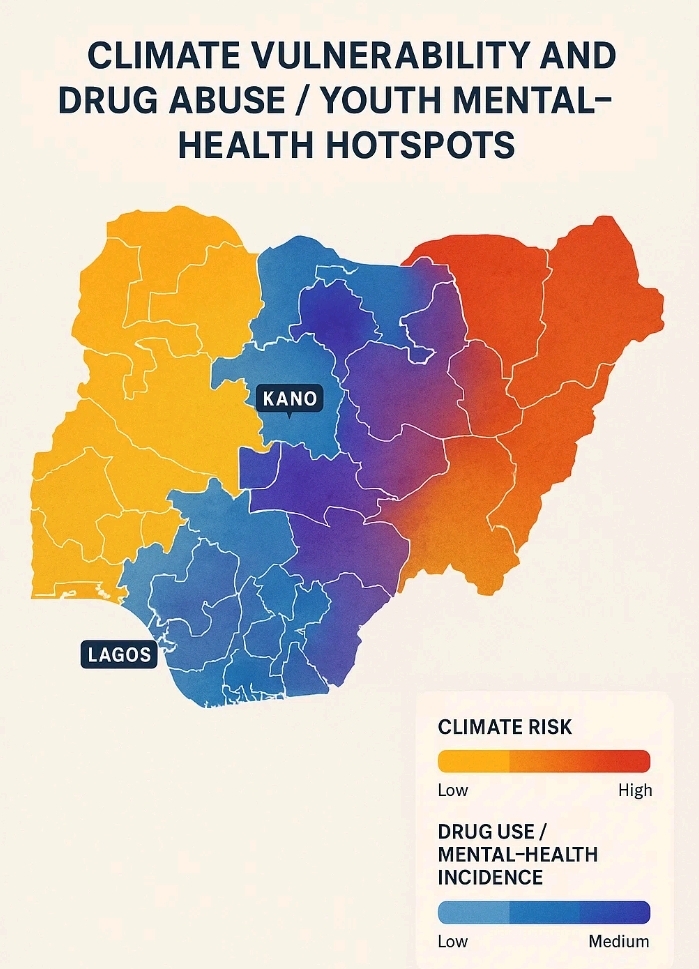
Every young person in Nigeria now moves through an environment that intensifies stress. Heat waves disrupt concentration and sleep. Floods destroy family income. Erratic rainfall wipes out seasonal livelihoods. Rising food and fuel prices eat into already thin margins. And beneath it all, there is the invisible psychological weight of living in a country where the terrain itself feels unstable. Climate change in Nigeria is not abstract; it is physiological, economic, and emotional.
Layered onto this is a mental-health burden that can no longer be ignored. Anxiety, despair, social withdrawal, and emotional exhaustion are becoming common experiences for young people across urban and rural spaces alike. These are not signs of moral weakness; they are indicators of a generation carrying more stress than the system was built to handle. Climate instability amplifies these pressures. When the environment becomes unpredictable, life feels unpredictable. When survival becomes unstable, hope becomes fragile.
The surge in synthetic drug use among Nigerian youth must also be understood through this lens. It is too easy and too misleading to label it as “moral decay.” Drug use thrives where young people feel overwhelmed, unsupported, and disconnected from formal systems of care. Many seek escape because they cannot find relief. They self-medicate because structured mental-health care is out of reach. They lean on substances because economic realities and climate stress constantly erode their sense of control. Until Nigeria addresses the structural conditions driving these behaviours, the crisis will deepen no matter how many arrests are made.
Perhaps the most troubling shift is the erosion of trust. Young people are losing confidence in institutions that once served as anchors, like schools, health systems, public agencies, even community structures. This distrust is not driven by cynicism but by lived experience. They see systems that are either absent, overstretched, or operating too slowly to respond to the speed and scale of modern challenges.
The result is a dangerous form of individualised survival where youth are forced to self-manage everything: self-therapy through the internet, self-education through YouTube, self-employment through hustling, self-protection because security systems are thin, and self-medication because health systems are inaccessible. But resilience should never be a solo assignment. A nation that leaves its youth to navigate crises alone is building the foundations of future instability.
What this generation needs is not pity or speeches but a coherent architecture of stability. Nigeria must begin by placing psychosocial support at the heart of its public-health strategy. Mental-health care must become accessible, affordable, and youth-friendly.
The health system must also evolve into a climate-conscious one, capable of anticipating and responding to heat-related illnesses, climate-linked disease patterns, and the environmental drivers of stress. The drug crisis requires a fundamental reset, from criminalisation to early intervention, from stigma to treatment, from fear-based campaigns to realistic, evidence-based prevention.
Above all, Nigeria needs a national youth stability strategy like a single, unified framework that connects climate risk, mental health, drug prevention, employment, community resilience, and digital engagement into one coordinated system. Anything less will leave young Nigerians trapped in the same cycle of crisis and coping.
The Climate Generation is not asking for perfect governance or instant solutions. They want honesty, presence, and protection. They want a country that understands what they are up against. They want a future that is not guaranteed, but at least possible.
Nigeria still has a chance to meet this generation with courage and clarity. If we fail to act, we risk inheriting a society defined by untreated trauma and chronic instability. But if we respond now, with empathy and vision, we can unlock the full potential of the generation most capable of rebuilding this country.
The Climate Generation is calling. The only question that remains is whether Nigeria will finally answer.
Omonon serves as the Counselor/Recovery Coach and Head of Programs at the Flag Foundation of Nigeria. She welcomes engagement from researchers, practitioners, and institutions working at the intersection of youth resilience, mental health, climate stress, and substance-use recovery. She can be reached via email at omydel@yahoo.com or WhatsApp at 0706 928 8295 for collaboration, program support, or further inquiry.