

From pioneering health journalism and women’s advancement to public health advocacy, civil society leadership and strategic public relations, Chief Moji Makanjuola’s continental recognition at the 10th Africa Women Conference celebrates a remarkable career devoted to using communication for social transformation.
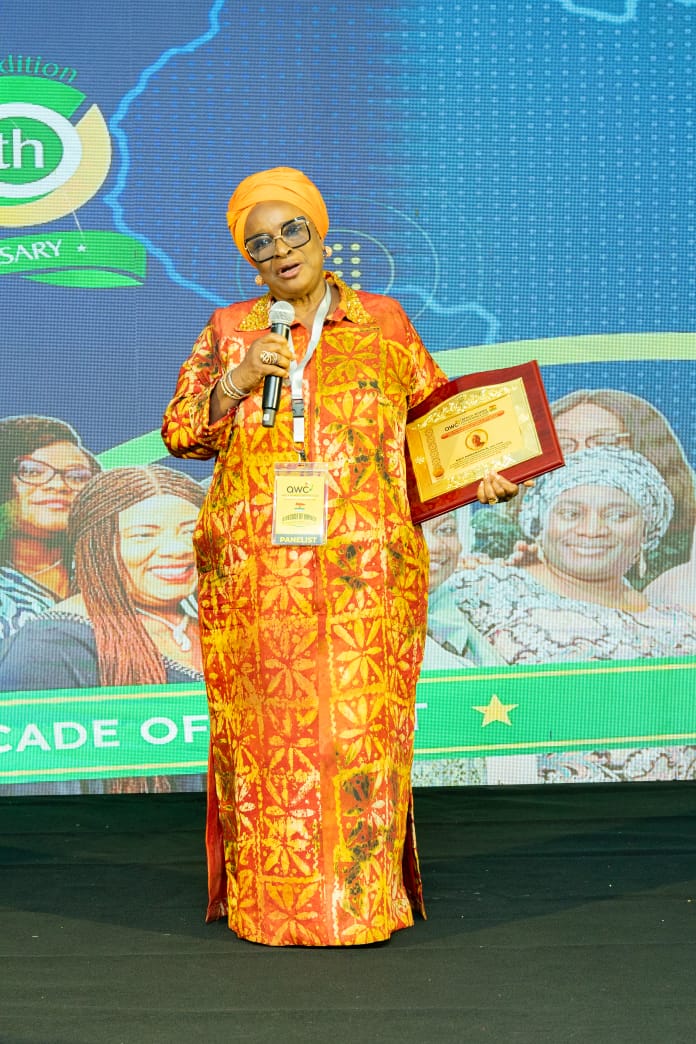
Chief Dr. Mrs Moji Makanjuola, MFR, FNIPR displays the Award she bags at African Women Conference at Accra Ghana recently.
By Abdulrahman Aliagan,
There are honours that celebrate professional accomplishments, and there are recognitions that acknowledge the enduring impact of an individual’s contribution to society. For Chief Moji Makanjuola, MFR, FNIPR, her recent recognition in Accra, Ghana, as a Doyenne of Media in Africa belongs to the latter category.
The Nigerian veteran broadcaster, journalist, health communication advocate and public relations practitioner was honoured at the 10th Anniversary Edition of the Africa Women Conference (AWC), held from November 4 to 6, 2026, in Accra, Ghana.
The recognition, formally designated the Lifetime Achievement in Broadcasting, Health and Gender Award, was bestowed in acknowledgement of her distinguished contributions to broadcasting and journalism, as well as her unwavering dedication to advancing health, gender equality and the well-being of women and girls.
The honour represents a significant continental acknowledgement of a professional journey that has traversed the traditional newsroom, public broadcasting, specialised health journalism, gender advocacy, civil society engagement and strategic public relations.
It is particularly significant that the recognition came during the 10th anniversary edition of a continental conference dedicated to advancing the interests, leadership and development of African women and girls.
With the theme, A Decade of Impact: From Commitments to Action—Advancing Justice, Economic Power, and Leadership for African Women and Girls, the conference provided an appropriate platform for celebrating a professional whose career has consistently demonstrated the relationship between media, women’s empowerment, public health and sustainable development.
For Makanjuola, the Ghanaian honour is not simply another addition to an impressive collection of professional recognitions. It is an acknowledgement of a lifetime spent expanding the frontiers of journalism and demonstrating that communication can be a powerful instrument for improving human lives.
Indeed, her story is not merely that of a journalist who reported events. It is the story of a woman who identified gaps in the media’s treatment of critical development issues and devoted her professional life to addressing them.
The Making of a Media Trailblazer
Chief Moji Makanjuola’s professional journey began in broadcasting at a time when the Nigerian media industry was largely dominated by established institutional structures, with relatively limited opportunities for women to occupy influential editorial and managerial positions.
She started as the first television announcer of the then National Television Broadcast in Kwara State before joining the Nigerian Television Authority (NTA), where she would eventually establish an enduring professional identity.
Her career at NTA spanned approximately 35 years, during which she distinguished herself through broadcasting, presentation, editorial responsibilities and specialised reporting.
One of her most significant contributions was establishing the Health and Gender Desk at NTA, becoming a pioneer in institutionalising specialised attention to issues that had not received sufficient consideration in mainstream broadcast journalism.
Her professional responsibilities also included leadership roles in the Presentation and Reportorial Units.
The establishment of the Health and Gender Desk was more than an administrative achievement. It represented a deliberate effort to create editorial space for issues affecting the health, rights and welfare of Nigerians, particularly women and vulnerable populations.
At a time when health reporting was not sufficiently developed as a specialised area of journalism in Nigeria, Makanjuola recognised the need for journalists to acquire deeper knowledge of healthcare systems, medical information, public health policies and the social factors influencing people’s well-being.
Her professional evolution was therefore not simply about rising through the ranks of a broadcasting institution. It was about identifying an important gap in journalism and creating a professional pathway around it.
When Personal Tragedy Became a Public Health Mission
Perhaps one of the most compelling aspects of Makanjuola’s story is the personal experience that strengthened her commitment to health journalism.
Her passion for health reporting was influenced by the loss of her mother following a road accident in which internal bleeding was reportedly not detected in time.
The experience exposed her to the devastating consequences of weaknesses in emergency response, diagnosis and healthcare delivery.
Rather than allowing the tragedy to remain a private family experience, she transformed it into a professional commitment to drawing attention to healthcare deficiencies and institutional failures that could cost ordinary Nigerians their lives.
She began to see journalism as an instrument for questioning healthcare standards, demanding improvements in medical infrastructure and helping citizens understand issues that directly affect their survival.
This experience underscores an important distinction between routine health reporting and public health journalism.
While routine reporting may concentrate on medical conferences, hospital announcements, government interventions and disease outbreaks, public health journalism interrogates the systems, policies, behaviours and institutional responsibilities that determine whether people receive quality healthcare.
This philosophy has informed much of her subsequent professional engagement.
Her position is particularly relevant in a country where inadequate health information, misinformation, poor healthcare access and weak accountability continue to undermine public health outcomes.
For Makanjuola, health journalism must be more than a specialised newsroom assignment. It must be a public service commitment.
Polio, Vaccination and the Power of Informed Journalism
One of the most instructive chapters of Makanjuola’s contribution to health journalism is her involvement in public enlightenment efforts during Nigeria’s polio vaccination controversy.
During the early 2000s, vaccination programmes encountered resistance in parts of northern Nigeria amid concerns and misinformation surrounding the safety of oral polio vaccines.
Rather than treating the controversy as another political or religious disagreement, Makanjuola approached it from the perspective of evidence-based public communication.
She participated in a fact-finding delegation that travelled to South Africa, Indonesia and India to understand vaccine production, safety and administration.
The experience helped equip her with the information necessary to communicate the science behind immunisation and counter public misconceptions.
According to her account in an interview with Nigeria Health Watch, the delegation subsequently presented its findings to state governors.
Among those who received the presentation was the then Katsina State Governor, Umaru Musa Yar’Adua, who issued an executive order directing the immunisation of children across the state’s wards.
The episode illustrates an important dimension of her professional philosophy: journalism and communication should not merely describe public health challenges; they should help society understand them and create the conditions for informed action.
It also demonstrates why specialised health journalism matters.
When journalists understand the science behind public health interventions, they become better positioned to counter misinformation, communicate risks responsibly and encourage evidence-based policy decisions.
ISMPH: Building an Institution Around the Power of Media
Perhaps the most enduring institutional expression of Makanjuola’s philosophy is the International Society of Media in Public Health (ISMPH), which she founded and leads as its Chief Executive.
The organisation was established around a fundamental proposition: media should be recognised as a strategic partner in public health development rather than treated merely as an external channel for disseminating health information.
ISMPH works to mainstream media in public health, promote evidence-based communication, strengthen health information dissemination and advance advocacy for equitable healthcare delivery.
Its work reflects Makanjuola’s understanding that healthcare delivery cannot be separated from the availability of credible information, public participation and institutional accountability.
Through the organisation, she has worked to strengthen the capacity of journalists to report health issues accurately, responsibly and with a better understanding of their implications for individuals and communities.
Its interventions have included media capacity-building initiatives, stakeholder engagement, public health advocacy and strategic communication around reproductive, maternal, newborn, child and adolescent health and nutrition.
A notable example is the three-year pilot initiative involving Lagos, Kano and Kaduna States, implemented through collaboration with the Lagos State Government and other stakeholders to improve ethical and impactful reporting on reproductive, maternal, newborn, child and adolescent health and nutrition.
The initiative recognises that journalists need more than access to press releases and health-sector events. They require specialised knowledge, professional training and the ability to translate technical health information into language that ordinary citizens can understand.
ISMPH’s approach also places considerable emphasis on the relationship between health communication and accountability.
For instance, when public resources are allocated to primary healthcare facilities, journalists should investigate whether the resources actually reach the facilities, what improvements they produce and whether patients experience better services.
This is journalism as a development instrument.
It is also civil society engagement in its practical form: organising stakeholders, strengthening public awareness, facilitating institutional dialogue and encouraging public institutions to fulfil their responsibilities.
Under Makanjuola’s leadership, ISMPH has provided a platform through which media professionals, development partners, public health institutions and civil society stakeholders can work together.
Her engagements with international institutions and development organisations, including the World Health Organization, UNFPA, UNAIDS, UNESCO, UN Women, USAID, the African Development Bank and the European Union, further illustrate the breadth of her professional engagement.
This combination of journalism, advocacy and institutional development distinguishes her contribution to the African media landscape.
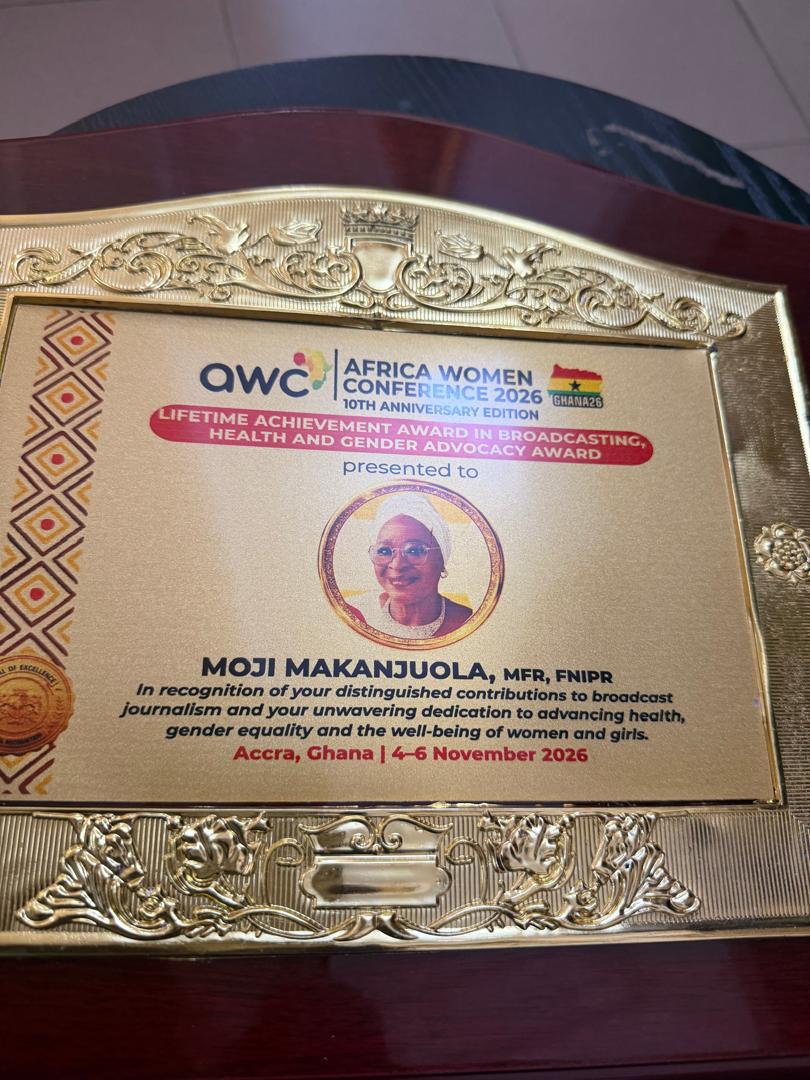
Award in recognition of her contributions to broadcast-Media, Journalism, Public Relations and Advicacy sectors
A Woman Who Helped Open Doors for Other Women
Any serious assessment of Chief Makanjuola’s professional legacy would be incomplete without examining her contribution to the advancement of women in journalism.
Her involvement in the Nigeria Association of Women Journalists (NAWOJ), where she served as National President, placed her among the women who helped establish and strengthen an important professional platform for female journalists in Nigeria.
At a time when women journalists were negotiating their place in a predominantly male professional environment, the importance of organised professional representation could not be underestimated.
NAWOJ provided a collective platform for addressing the challenges confronting women in the profession, promoting professional development, encouraging leadership participation and advocating greater visibility for women in media institutions.
Makanjuola’s leadership helped strengthen the association’s place within Nigeria’s media ecosystem.
Her contribution to women’s journalism, however, extends beyond occupying a leadership position.
Through her professional example, mentorship and advocacy, she has consistently demonstrated that women can occupy influential positions in broadcasting, editorial leadership, institutional management, public communication and national development discourse.
Her pioneering establishment of the Health and Gender Desk at NTA was particularly significant.
By institutionalising attention to health and gender issues within a major national broadcasting organisation, she helped create space for subjects that were frequently marginalised in mainstream media coverage.
The significance of this intervention cannot be divorced from the broader struggle for women’s representation in journalism.
Representation is not simply about the number of women employed in newsrooms. It is also about who determines editorial priorities, whose experiences receive public attention and who occupies positions where professional decisions are made.
In this respect, Makanjuola’s career offers an important example of how women can influence both the composition and the direction of media institutions.
Her mentorship of younger journalists, particularly women, has also contributed to sustaining the professional values of integrity, diligence, confidence and public service across generations.
Her recognition in Ghana as a Doyenne of Media in Africa therefore carries symbolic significance for women journalists across the continent.
It celebrates not only a successful professional but also a woman whose career has helped demonstrate what is possible when competence, institutional leadership and purposeful mentorship converge.
Beyond Journalism: The Public Relations Dimension
Another important dimension of Makanjuola’s professional identity is her contribution to public relations and strategic communication.
Her credentials as a Fellow of the Nigerian Institute of Public Relations (FNIPR) reflect her standing within the organised public relations profession.
Through her communications consultancy, Bronz & Onyx International Limited, she has extended her professional engagement into strategic communications, media consultancy and integrated communication solutions.
This dimension of her career is particularly important because it reveals her understanding of the relationship between information, public perception, institutional credibility and public trust.
Journalism and public relations are distinct professional disciplines, with different mandates and ethical obligations.
Journalism is fundamentally concerned with independent reporting, public-interest scrutiny and accountability, while public relations focuses on strategic communication and the management of relationships between organisations and their publics.
Makanjuola’s experience across both fields gives her a broad understanding of how institutions communicate, how citizens receive information and how public confidence can be strengthened or undermined.
Her work with development partners, government institutions and civil society organisations has further expanded her understanding of communication as a tool for social transformation.
Her involvement in strategic public communication also reinforces an important lesson for the African media industry: professional communication must be rooted in credibility, consistency, evidence and an understanding of the people it seeks to reach.
In an age characterised by misinformation, declining media trust and the rapid spread of unverified information, these values are increasingly indispensable.
The Author, Documentary Producer and Advocate
Makanjuola’s professional contributions also extend into authorship and documentary production.
Her book, Health Journalism: A Journey with Moji Makanjuola, provides an additional dimension to her efforts to document and communicate the importance of specialised health reporting.
The publication is particularly relevant to younger journalists seeking to understand the development of health journalism and the responsibilities associated with reporting public health issues.
Her documentary work has similarly provided opportunities to explore development issues through visual storytelling.
These contributions demonstrate that her engagement with journalism has never been restricted to one medium or professional format.
Whether through television broadcasting, writing, documentary production, public relations or civil society advocacy, her central concern has remained the use of communication to influence society positively.
Her national recognition also includes the Member of the Order of the Federal Republic (MFR), conferred in 2014 by former President Goodluck Jonathan.
The establishment of the Moji Makanjuola Award for Public Health Journalism by the Academy of Public Health, in partnership with the West African Institute of Public Health and ISMPH, is another indication of the professional significance attached to her contributions.
In September 2026, Ojoma Akor became the inaugural recipient of the award, recognising her contribution to public health reporting and evidence-based journalism.
There is a special significance in seeing an award bearing Makanjuola’s name recognise another journalist.
It suggests that her influence is increasingly moving beyond personal accomplishments towards the institutional recognition and encouragement of the next generation of health journalists.
Accra and The Significance of a Continental Recognition
The choice of the 10th Africa Women Conference as the platform for recognising Makanjuola’s contributions adds another important dimension to the honour.
The conference, an initiative of the Helpline Foundation for the Needy Abuja in collaboration with Echoes Africa Initiatives, New York, has evolved into a continental platform bringing together women leaders, policymakers, development partners, entrepreneurs, academics, civil society organisations and other stakeholders interested in advancing the development of African women and girls.
Its 10th anniversary edition in Accra, Ghana, was particularly significant.
Under the theme, A Decade of Impact: From Commitments to Action—Advancing Justice, Economic Power, and Leadership for African Women and Girls, the gathering challenged participants to move beyond declarations and focus on practical interventions capable of producing measurable improvements in women’s lives.
The conference’s focus on justice, economic empowerment, inclusive leadership and institutional accountability resonates strongly with Makanjuola’s professional trajectory.
Her career has consistently demonstrated the importance of amplifying women’s voices, communicating health information, strengthening public awareness and using media to influence policies and institutional behaviour.
Her recognition under the Lifetime Achievement in Broadcasting, Health and Gender Award therefore connects her professional achievements directly with the central objectives of the conference.
It also reinforces the importance of recognising women whose contributions to society are not necessarily measured by political office or corporate wealth but by the institutions they build, the people they empower and the lives their work touches.
For African journalism, the honour is equally instructive.
The continent’s media industry is undergoing profound changes. Digital transformation, artificial intelligence, declining media revenues, misinformation, threats to press freedom and the growing complexity of public health challenges are redefining the responsibilities of journalists and communication professionals.
These developments require a media profession that understands its responsibilities beyond the daily production of news.
They require journalists who can interrogate policies, interpret scientific evidence, communicate responsibly, amplify marginalised voices and hold institutions accountable.
Makanjuola’s professional journey has consistently reflected these responsibilities.
Her contribution to health journalism demonstrates the importance of specialised reporting.
Her work with NAWOJ reflects the importance of women’s leadership and professional inclusion.
Her leadership of ISMPH demonstrates how civil society organisations can mobilise media expertise to address development challenges.
Her public relations practice illustrates the strategic importance of communication in building institutional credibility and public trust.
Taken together, these contributions provide a compelling explanation for why her professional influence deserves recognition beyond Nigeria.
The Legacy Is Bigger than the Award
Chief Moji Makanjuola’s professional story remains a testament to the possibilities of purposeful service.
She has occupied the broadcasting studio, led professional associations, established a specialised health reporting desk, founded a civil society organisation, mentored younger journalists, worked with international development institutions and contributed to the evolution of strategic public communication.
But perhaps the most significant measure of her legacy is not the number of positions she has occupied or the honours she has received.
It is the professional and institutional pathways she has helped create for others.
When a young journalist decides to specialise in health reporting, the foundations she helped establish become relevant.
When a woman journalist finds the confidence to pursue leadership in a newsroom, the example she has provided becomes relevant.
When a civil society organisation recognises media as a strategic partner in public health advocacy, the philosophy behind ISMPH becomes relevant.
And when communication professionals insist that public trust must be built on credibility, evidence and consistency, the values she has championed become relevant.
The Ghanaian recognition as a Doyenne of Media in Africa is therefore an important addition to a career whose influence has never been confined to national boundaries.
It is a recognition of a woman who has spent decades demonstrating that the power of journalism lies not merely in its ability to tell society what is happening, but in its capacity to help society understand why it is happening, who is affected and what must change.
The Lifetime Achievement in Broadcasting, Health and Gender Award is consequently more than a celebration of professional longevity. It is an acknowledgement of the intersection of journalism, public health, gender equality and social development.
Ghana may have provided the latest stage for the celebration, but the story of Moji Makanjuola’s contribution to media, public health and women’s advancement has been written across decades of service to Nigeria and Africa.
Her greatest achievement may ultimately not be the awards she receives, but the lives influenced, institutions strengthened, professional doors opened and generations of journalists inspired by her example.
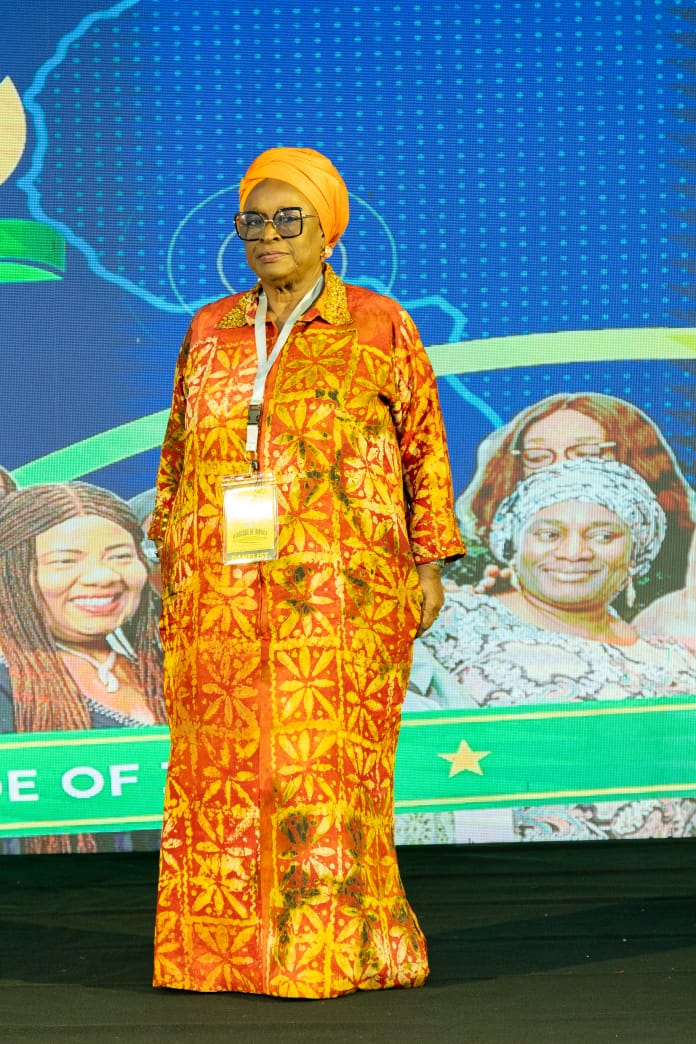
The Doyenne of Media at African Women Conference herself flanked gorgeously in a photograph in Accra Ghana.
- Aliagan is an Abuja-based seasoned Journalist, Managing Editor of Time Nigeria Magazine and President of Nigerian Guild of Investigative Journalists (NGIJ).