


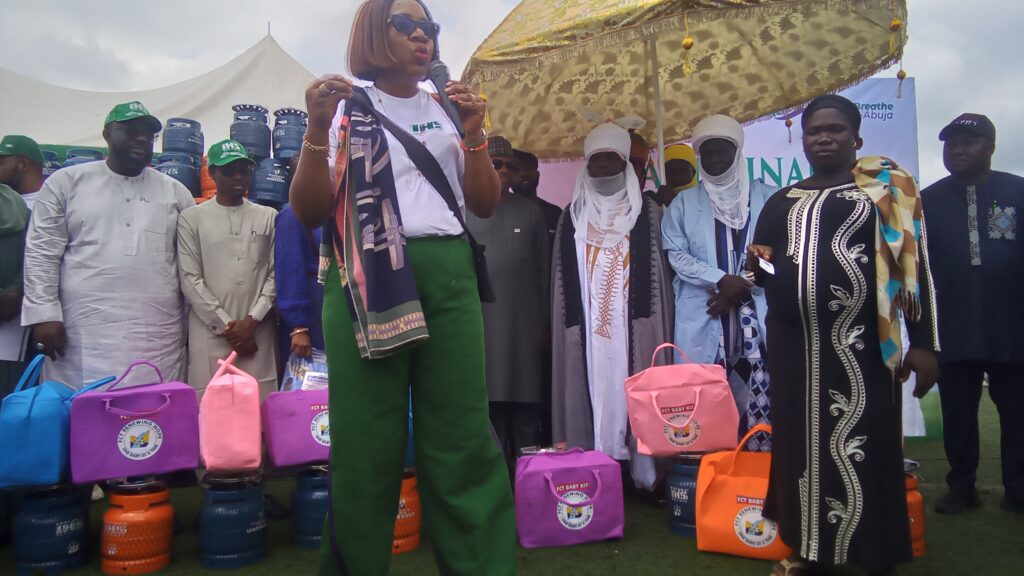
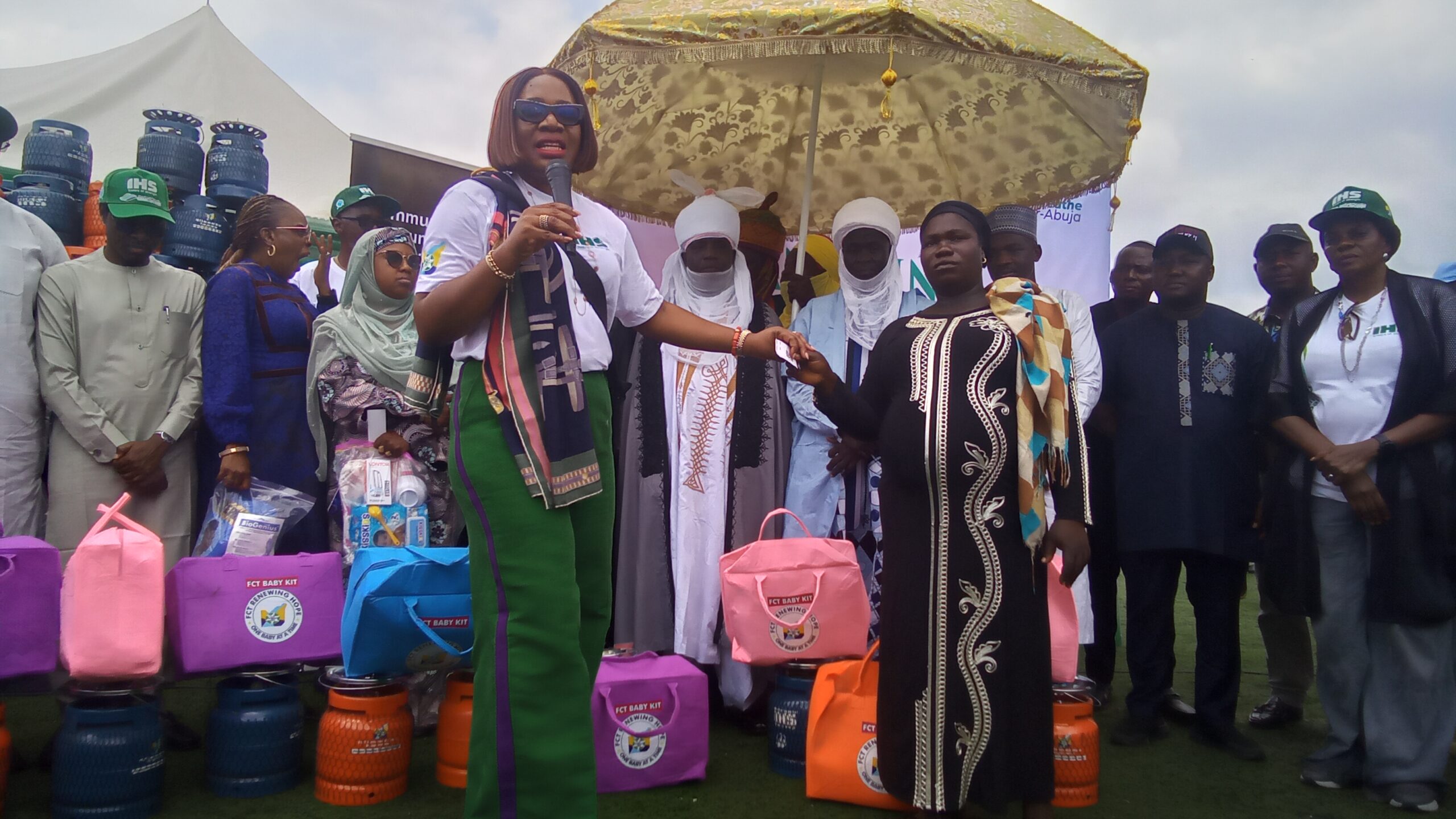
The Mandate Secretary of the Health Services and Environment Secretariat (HSES), Dr. Dolapo Fasawe presenting a voucher for the refill of the Gas Cylinder to one if the beneficiaries at the Grand Finale ceremony at the Bwari Area Council Stadium, Abuja yesterday.
By Abdulrahman Aliagan,
For decades, the sight of smoke rising from firewood stoves has been a familiar feature across many communities in the Federal Capital Territory (FCT). In rural settlements and even parts of the nation’s capital, thousands of families have relied on firewood and charcoal as their primary cooking fuel, unaware that the smoke filling their kitchens silently threatened their health, shortened lives and contributed to environmental degradation.
Today, that narrative is gradually changing. Through an ambitious partnership between the Federal Capital Territory Administration (FCTA) and IHS Nigeria, under the Project Breathe Clean Air–Abuja, more than 12,500 households across the six Area Councils have begun transitioning from traditional biomass fuels to cleaner and safer Liquefied Petroleum Gas (LPG), marking one of the most significant clean cooking interventions ever undertaken in the nation’s capital.
The initiative reached a historic milestone on Thursday with its grand finale held in Bwari Area Council, where hundreds of beneficiaries received LPG cylinders, burners and refill vouchers, bringing months of community engagement, awareness campaigns and phased distributions to a successful conclusion.
What began in November 2025 as a programme targeting 5,000 households steadily expanded through additional phases until over 12,500 families had benefited across the six Area Councils of Abuja.
More Than Free Gas Cylinders
Although the distribution of cooking gas equipment attracted public attention, officials insist the programme was never simply about giving away cylinders.
Rather, it was conceived as a long-term public health intervention designed to reduce the devastating effects of indoor air pollution, one of the world’s most overlooked environmental health risks.
Speaking during the grand finale, the Mandate Secretary of the Health Services and Environment Secretariat (HSES), Dr. Dolapo Fasawe, explained that the project was born after authorities discovered that many Abuja residents, including those living within the city centre, still depended heavily on firewood for daily cooking.
According to her, prolonged exposure to smoke from firewood contributes significantly to respiratory infections, eye irritation, allergies, burns and environmental pollution.
Instead of merely discouraging residents from using firewood, the Administration decided to provide a practical and affordable alternative.
The result was the Abuja Breathe Clean Air Initiative, supported through funding by IHS Nigeria.
The intervention has now enabled more than 12,500 households to adopt cleaner cooking methods, improving household health, reducing cooking expenses and increasing productivity among small-scale food vendors who previously depended on firewood and charcoal.
To ensure sustained adoption, beneficiaries also received refill vouchers alongside intensive safety training on the proper handling and use of LPG.
Taking the Campaign Across Abuja
Unlike many intervention programmes concentrated in urban centres, Project Breathe Clean Air deliberately reached communities across all six Area Councils of the FCT.
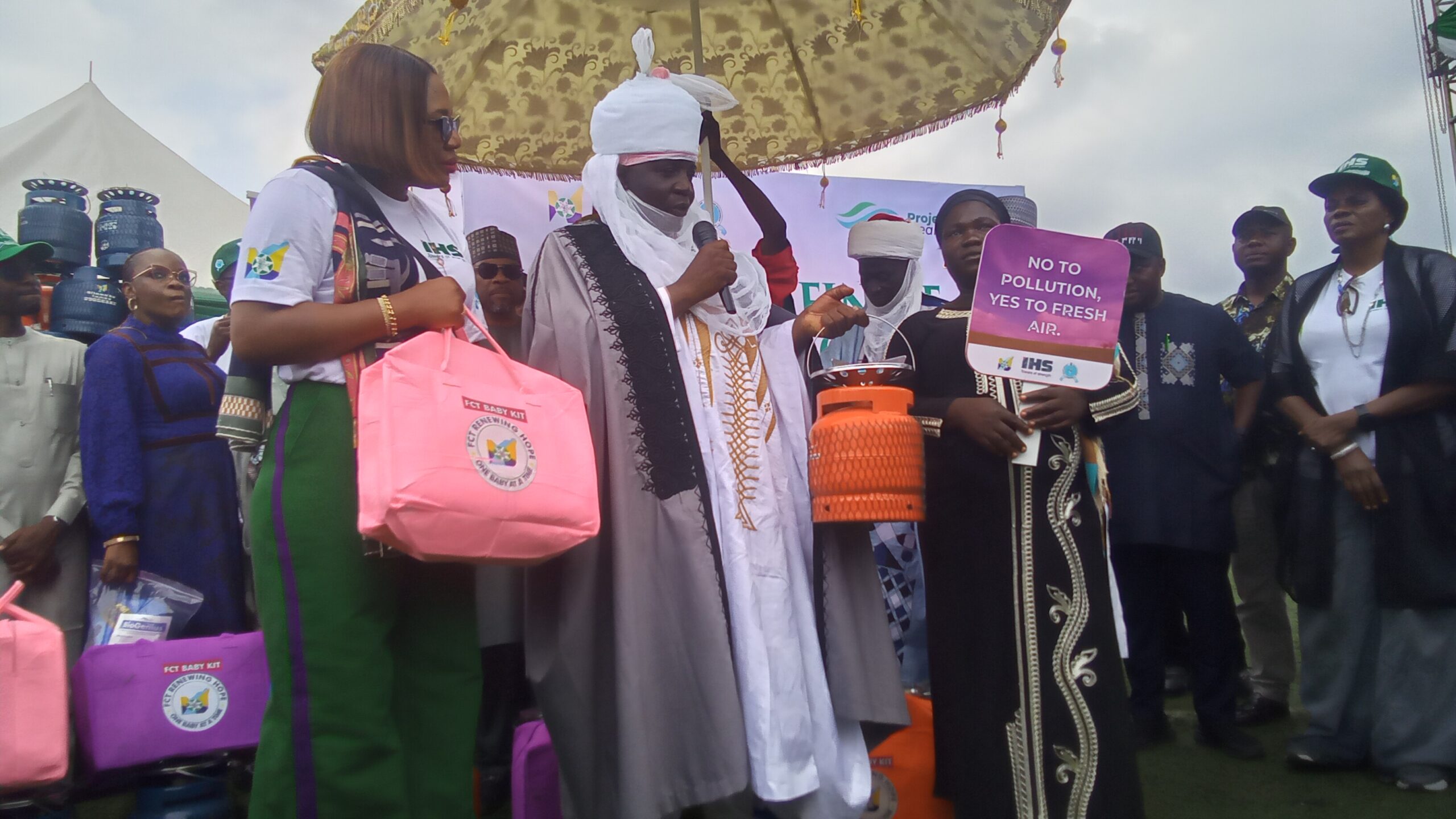
The Etsu Bwari, Dr Ibrahim Yaro (JP) presenting the Gas Cylinder to o e of the beneficiaries and educating his subjects about the significance of the Initiative
Following its launch, the FCTA embarked on extensive community engagement tours covering: Kuduru Ward in Bwari Area Council, Kuchigoro Ward in Abuja Municipal Area Council (AMAC), Ayaura Ward – Abaji Area Council, Yangoji Ward in Kwali Area Council, Sabon Gari Ward in Gwagwalada Area Council and Jeida Ward in Kuje Area Council.
Traditional rulers, community leaders, healthcare workers and environmental officers were mobilised to educate residents on the dangers of indoor smoke and the economic benefits of switching to LPG before distributions commenced in each council.
The phased implementation ensured that vulnerable households—including women-led families, elderly residents and persons living with disabilities—were prioritised.
Why Women and Children Face the Greatest Risk
Globally, public health experts have consistently identified indoor air pollution as one of the leading environmental causes of disease among women and young children.
In many Nigerian homes, women spend several hours daily preparing meals over firewood stoves, often carrying babies on their backs while cooking.
The smoke produced from burning wood contains dangerous pollutants, including fine particulate matter and carbon monoxide, which penetrate deep into the lungs.
Medical experts warn that continuous exposure increases the risks of chronic respiratory diseases, pneumonia, asthma, cataracts and cardiovascular complications. For pregnant women, the dangers are even greater.
Research has linked prolonged exposure to firewood smoke with pregnancy complications such as low birth weight, premature delivery and increased risk of stillbirth due to reduced oxygen supply to the unborn child.
Children under five remain especially vulnerable because their lungs are still developing. Regular inhalation of smoke significantly increases their susceptibility to pneumonia, acute respiratory infections and impaired lung development.
These health concerns formed one of the strongest justifications for the Abuja clean cooking initiative.
Representing the Minister of State for the FCT, Dr. Mariya Mahmoud, at the grand finale, Special Adviser Majeed Adamu noted that indoor air pollution disproportionately affects women and children because they spend more time around household cooking areas.
Environmental Gains Beyond the Kitchen
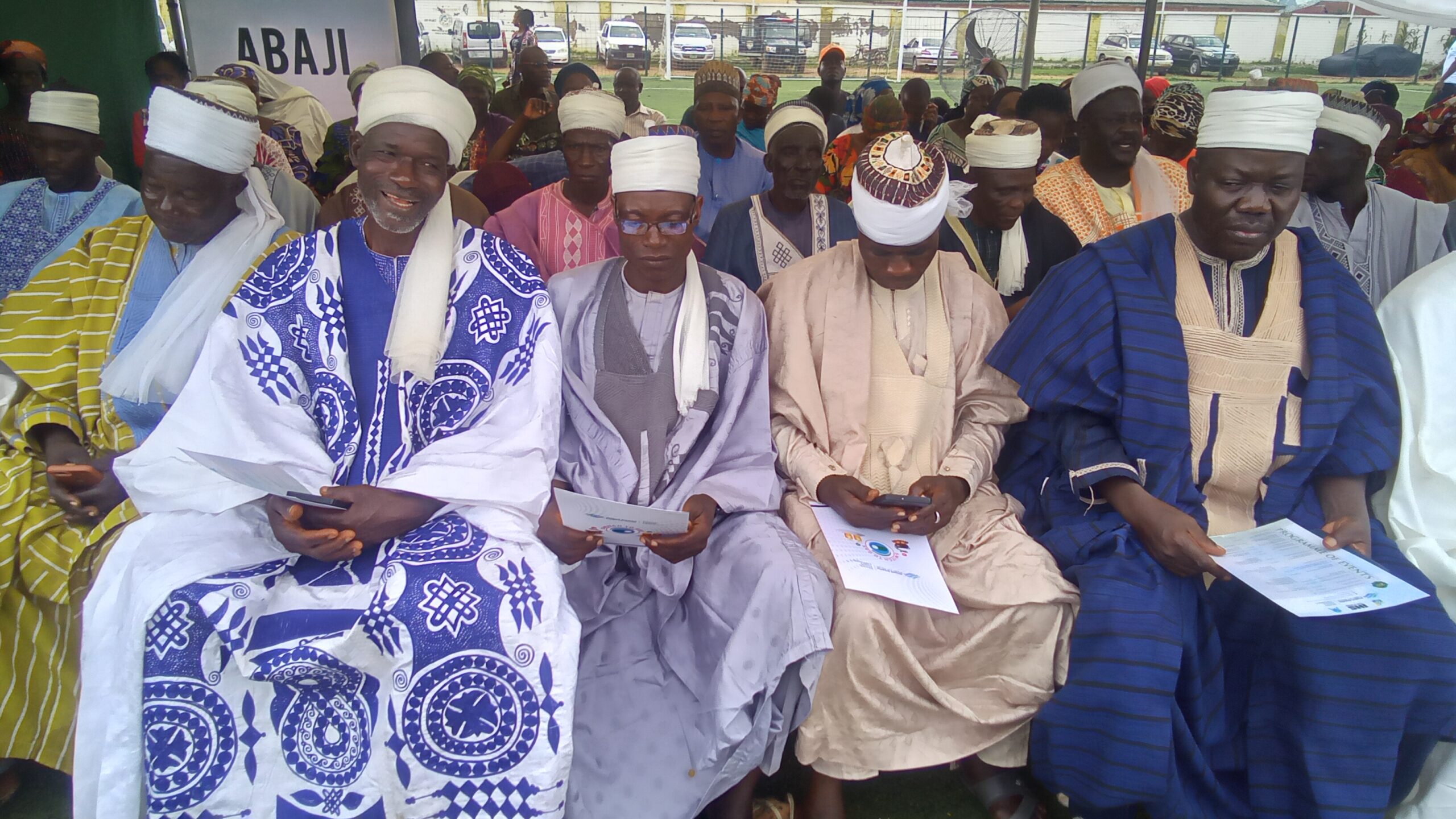
Cross-session of community leaders present at the event.
The benefits extend far beyond improved household health. Nigeria loses thousands of hectares of forest annually to fuelwood harvesting, with increasing pressure on surrounding forests supplying urban centres.
Every household that transitions from firewood to LPG reduces demand for indiscriminate tree felling, helping conserve biodiversity, improve air quality and mitigate climate change.
Reduced dependence on charcoal also lowers carbon emissions and contributes to national environmental sustainability goals.
Officials believe that if replicated nationwide, clean cooking initiatives could substantially reduce deforestation while supporting Nigeria’s commitments toward climate action.
Economic Relief for Families
The programme also addresses a growing economic challenge.
According to the FCTA, many low-income households spend approximately ₦1,500 daily purchasing firewood.
In comparison, an LPG refill costing around ₦4,000 can last an average family for more than a month, depending on usage.
Beyond reducing cooking costs, LPG enables faster meal preparation, allowing women and small-scale food vendors to devote more time to income-generating activities.
The provision of refill vouchers further cushions beneficiaries during the transition period, encouraging continued use of clean cooking energy rather than a return to firewood.
We Are Expanding Social Investment in Nigeria – Dapo Otunla IHS Nigeria
For IHS Nigeria, the initiative forms part of a broader sustainability agenda.
Representing the Executive Vice President and Chief Executive Officer of IHS Nigeria, Mohamad Darwish, the company’s Senior Vice President and Chief Corporate Services Officer, Dapo Otunla, described the project as a practical demonstration of the company’s commitment to environmental sustainability and community development.
He disclosed that IHS fulfilled its commitment by donating 10,000 LPG cylinders in phases across the FCT while simultaneously enrolling 2,000 beneficiaries into its “Clinic Without Walls” health insurance scheme.
According to him, the project aligns with IHS Nigeria’s environmental and community sustainability pillars by reducing dependence on biomass fuels, improving public health and enhancing the quality of life of vulnerable households.
Otunla praised the collaboration between the FCTA, traditional institutions and community leaders, describing it as a model partnership capable of delivering measurable improvements in health, environmental protection and community resilience.
Communities Welcome a Breath of Fresh Air
For many beneficiaries, the intervention represents far more than access to a modern cooking appliance.
Sarah Monday, one of the beneficiaries from Bwari Area Council, expressed excitement after receiving her first gas cylinder.
According to her, the support would make cooking easier and safer for her family.
She also commended organisers for providing practical demonstrations on the safe handling and use of LPG, promising to permanently adopt clean cooking methods.
Across the various Area Councils visited during the programme, similar sentiments echoed among beneficiaries, many of whom described the intervention as life-changing.
Looking Beyond the Grand Finale
Although the official distribution exercise has ended, health officials insist that the campaign itself is only beginning.
The FCTA hopes the success of Project Breathe Clean Air–Abuja will provide the foundation for future policies promoting wider adoption of clean cooking energy throughout the Federal Capital Territory.
If sustained through supportive regulations, expanded LPG access and continued public education, the initiative could significantly reduce preventable illnesses, ease pressure on Nigeria’s forests, lower household energy costs and improve the quality of life for thousands more families.
For Abuja, the smoke rising from traditional kitchens is gradually giving way to a cleaner future—one gas flame, one healthier family and one protected forest at a time.