


By Abdulrahman Aliagan, Managing Editor, Time Nigeria Magazine
When 22-year-old Aisha Musa, a final-year student of Political Science at the University of Abuja, heard that the Academic Staff Union of Universities (ASUU) had suspended its two-week warning strike, she didn’t know whether to celebrate or sigh in frustration. “It’s always the same story,” she said, clutching her half-torn notebook as students hurried back to lectures. “They call off the strike, government promises something, then in a few months, another strike begins. We are just tired.”
Her words echo the sentiments of millions of Nigerian students who have grown up under a shadow of uncertainty — victims of a never-ending tug of war between ASUU and the Federal Government.
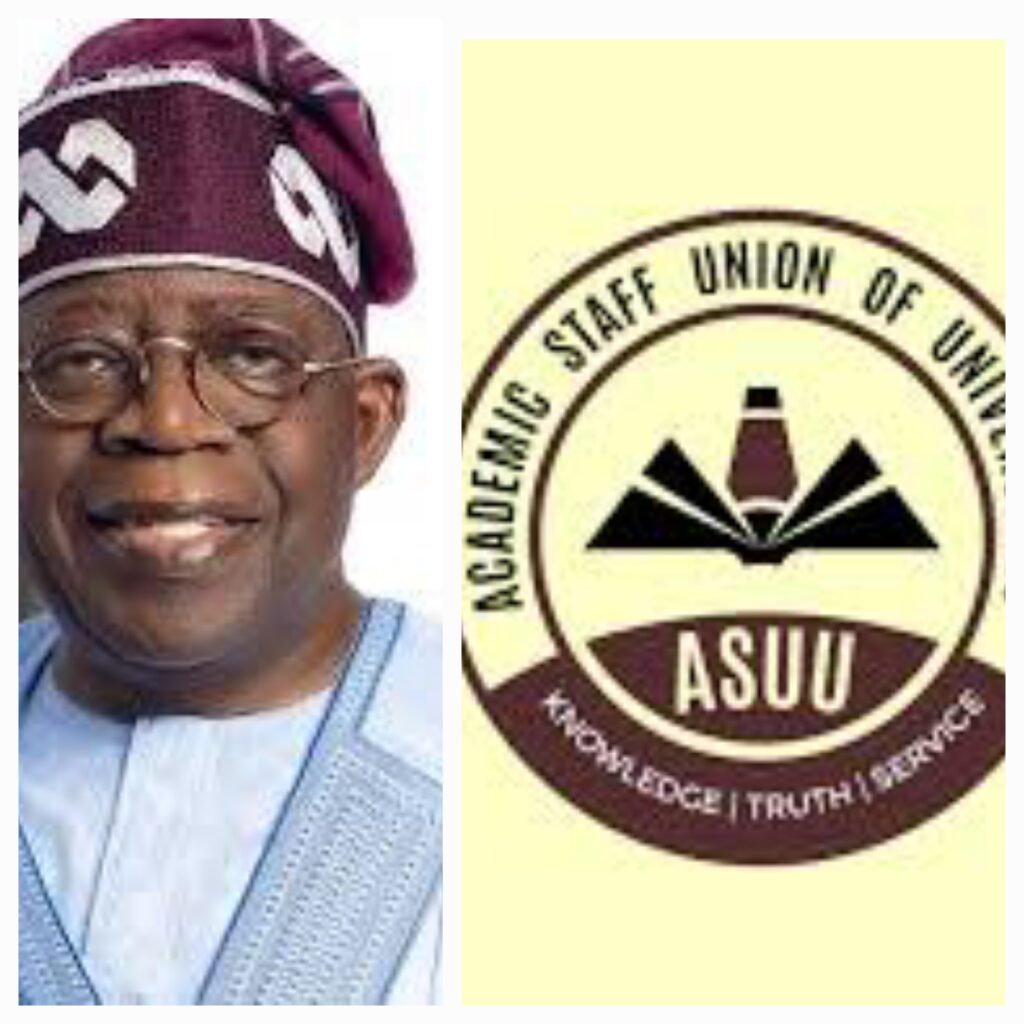
On Wednesday, the ASUU President, Dr. Chris Piwuna, announced the suspension of the strike at a press conference held at the union’s headquarters in Abuja. He revealed that the decision followed the intervention of the Senate and other well-meaning Nigerians who urged the union to give dialogue another chance. According to him, ASUU’s National Executive Council resolved to give the government a one-month window to address all outstanding issues, including the renegotiation of the 2009 Agreement, the revitalization of public universities, earned academic allowances, and payment platforms.
But beneath the polite language of “dialogue” lies years of deep-seated frustration. “We’ve been signing the same agreements since 2009,” lamented Dr. Felix Oyedepo, a senior lecturer at the University of Abuja.
“Every new administration promises reform, but the issues remain — poor funding, poor pay, and decaying infrastructure. Many of my colleagues have left for Ghana, South Africa, or the UK. The system is bleeding talent.”
During his 2023 presidential campaign, President Bola Ahmed Tinubu promised that under his leadership, Nigerian students would graduate as and when due and that strikes would become a thing of the past. That promise ignited hope among millions of young Nigerians who had seen their educational dreams derailed by ASUU’s perennial industrial actions.
However, barely two years into his administration, that commitment faces its first major test. While the President has expressed interest in educational reform — introducing the Students Loan Act and promising better funding for universities — the recurring ASUU crises suggest that deep structural issues remain unresolved.
Nigeria’s investment in education paints a grim picture. According to UNESCO, countries are advised to allocate between 15 percent and 20 percent of their annual budgets to education. Yet, Nigeria’s allocation in the 2025 budget proposal stands at less than 8 percent, one of the lowest in sub-Saharan Africa. The consequences are visible on every campus: leaking roofs, broken laboratories, overpopulated lecture halls, and lecturers who often struggle to survive on salaries that haven’t been reviewed in over a decade. A Professor in a Nigerian federal university earns less than ₦500,000 monthly, while an entry-level bank employee earns close to the same amount — without the research burden, teaching load, or intellectual demands of academia. “It’s humiliating,” said Dr. Kenneth a lecturer in the Faculty Education Ahmadu Bello University, Zaria. “We train the nation’s workforce — doctors, engineers, and leaders — yet we can’t afford decent living. That’s why morale is so low.”
Each strike creates ripples that go far beyond empty classrooms. Students’ dreams are delayed, research projects abandoned, and academic calendars distorted. Parents pay extra rent, transportation, and feeding costs — all while the nation’s productivity suffers. For many, the psychological toll is the heaviest. “It’s not just about losing time,” Aisha explained. “It’s about losing motivation. You see your friends abroad finishing degrees in three years, while you’re stuck repeating semesters for no fault of yours.”
The ripple effects extend to the nation’s reputation. Employers abroad often view Nigerian degrees with skepticism due to unstable academic calendars, while the local job market struggles with an oversupply of underprepared graduates.
Education policy analysts believe that the recurring ASUU strikes are merely symptoms of a bigger systemic collapse. According to Dr. Tunde Aremu, an education economist based in Abuja,
“Nigeria’s university crisis is not just about ASUU or salary arrears. It’s about how we view education as a nation. We treat it as an expense, not an investment.” He further argues that genuine reform must focus on long-term sustainability rather than crisis management.
“We need a national education endowment fund, autonomy for universities, competitive pay for lecturers, and strict accountability for university administrators,” he added.
Experts and stakeholders interviewed by Time Nigeria Magazine agree that to end the cycle of strikes, Nigeria must commit to honouring existing agreements. The Federal Government must back its words with action, implementing all pending agreements without delay. Education budgets should meet global standards, and funds must be monitored to ensure effective use.
Institutions should be empowered to manage finances, recruit staff, and design academic programs without undue political interference. Lecturers must be paid commensurate with their qualifications and workload to reduce the exodus of talent.
Nigeria’s universities must embrace digital learning, modern research facilities, and partnerships with the private sector. Finally, convening a high-level national education reform summit that brings together government, unions, students, and the private sector could help redesign Nigeria’s higher education architecture for the 21st century.
As the dust settles on ASUU’s suspended strike, all eyes are now on the Federal Government. The coming month presents a defining moment for President Tinubu’s administration — an opportunity to prove that his campaign promise was more than rhetoric.
If Nigeria truly hopes to compete in a global knowledge economy, it must treat education as a national security priority. A stable university system is not just about classrooms — it is about the future of a generation and the destiny of a nation. Until then, students like Aisha continue to wait, their dreams hanging in limbo, as the nation stands at yet another crossroads — between reform and relapse.