


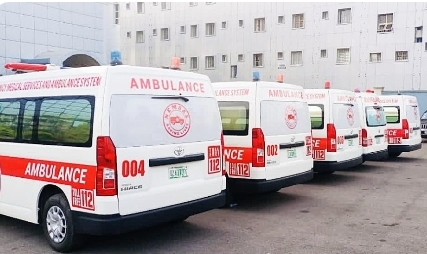
“Thirty-three states and the FCT already have State Emergency Medical Services and Ambulance Systems with varying numbers of ambulances. Twenty-one states are currently operational, while others are close to commencing operations,”
— Dr. Emuren Doubra,
By Abdulrahman Aliagan, Abuja
Nigeria’s emergency healthcare response system is gradually expanding across the country as the National Emergency Medical Service and Ambulance System (NEMSAS) deepens efforts to ensure timely medical intervention for citizens, particularly the poor and vulnerable.
The National Programme Manager of National Emergency Medical Service and Ambulance System (NEMSAS), Dr. Emuren Doubra, said the agency has continued to support states in establishing functional emergency medical service structures to manage ambulance operations and provide lifesaving care.
According to him, while recent discussions about NEMSAS highlighted its role within Nigeria’s Emergency Medical Service ecosystem and the Federal Government’s vision, several important contributions by the agency deserve further public attention.
Dr. Doubra explained that NEMSAS has worked with state governments to establish systems that coordinate ambulance services and provide free emergency care for poor citizens through both public and private state health facilities, as well as federal tertiary hospitals.
Across the country, he noted, NEMSAS-supported structures now exist in all 36 states and the Federal Capital Territory.
“Thirty-three states and the FCT already have State Emergency Medical Services and Ambulance Systems with varying numbers of ambulances. Twenty-one states are currently operational, while others are close to commencing operations,” he said.
Despite the progress, the NEMSAS programme manager acknowledged that Nigeria still does not have enough ambulances or equitable distribution across states.
“We cannot say we have an equitable distribution of ambulances or that we have enough ambulances, but we do have ambulances operational across these states,” he noted.
He further revealed that only three states are yet to establish formal State Emergency Medical Service and Ambulance Systems. However, residents in those states are not left without support, as designated federal tertiary health institutions have been empanelled to serve as interim EMS coordinating centres pending the establishment of state-level structures.
Dr. Doubra also pointed out that every state in the federation has access to emergency medical treatment funding opportunities under the Basic Health Care Provision Fund (BHCPF).
While some states have not yet begun to draw from the funding window, he explained that NEMSAS has already helped them establish the structures required to access the funds.
“It is one thing to set up a structure; it is another for the state to commence operations. We are optimistic about functionality and the benefits that will follow,” he said.
One of the major challenges facing emergency response in Nigeria, according to him, is communication.
Dr. Doubra explained that multiple emergency contact numbers exist today mainly because the primary national number is not always easily accessible during emergencies when people are under distress.
A recent nationwide survey conducted with the National Health Fellows across the 774 local government areas showed that about 80 percent of states have access to the national emergency communication number, 112. However, users often experience difficulties connecting on the first dial, while public awareness of the number remains low.
He therefore called on the Nigerian Communications Commission (NCC) to intensify efforts to improve both the reliability and public awareness of the 112 emergency number across all telecommunications networks.
According to him, accessibility to the number varies across mobile operators, with some networks performing better than others.
Another critical issue raised by the NEMSAS programme manager is the absence of a Good Samaritan law in Nigeria.
He noted that citizens who attempt to assist accident victims or people in medical emergencies sometimes face harassment or difficulties from law enforcement agencies.
Such experiences, he warned, discourage members of the public from helping those in distress, thereby worsening emergency situations.
“There is a need for a Good Samaritan Law that protects individuals who step in to help during emergencies,” he stressed.
Beyond ambulance response in urban areas, NEMSAS has also launched targeted interventions in rural Nigeria aimed at reducing maternal and newborn deaths.
One of such initiatives is the Rural Emergency Service and Maternal Transport programme, known as RESMAT.
The programme focuses on addressing what health experts describe as the “second delay” — the time it takes for pregnant women experiencing complications to reach a health facility.
Currently operational in 123 local government areas, the initiative has already produced notable results.
As of December 2025, more than 40,000 pregnant women from hard-to-reach communities have been transported to health facilities for delivery. An additional 11,200 women facing obstetric emergencies were also moved to designated comprehensive emergency obstetric and newborn care centres where they received successful treatment.
In addition, 1,680 newborn babies with medical emergencies have been transported to appropriate health facilities for urgent care.
Dr. Doubra emphasized that improving emergency response in Nigeria requires stronger collaboration among agencies involved in disaster response, health services, and telecommunications.
He particularly stressed the importance of improving the effectiveness and accessibility of the 112 emergency number nationwide.
He also urged Nigerians to embrace the growing emergency medical system and support ongoing reforms.
According to him, constructive engagement and public optimism will help strengthen emergency healthcare delivery across the country.
“Emergency medical services in Nigeria are evolving. With greater collaboration, awareness, and support from citizens, the system will continue to improve and save more lives,” he said.