

Residents who paid millions of naira for plots in a government-backed ‘world-class’ Government Reserved Area (GRA) in Ilorin have lived for over a decade without electricity, running water, or security and illegal conversion of residential plot to commercials. Eight transformer stations stand empty. Streetlight poles are being carted away by thieves in the night. Illegal sand miners are scooping the ground from beneath their feet. And the Kwara State Government, despite repeated written appeals, has not lifted a finger. Abdulrahman Aliagan of TIME NIGERIA Magazine visited the area and speaks with some residents of the New GRA Budo-Osho Ilorin. This is their story.
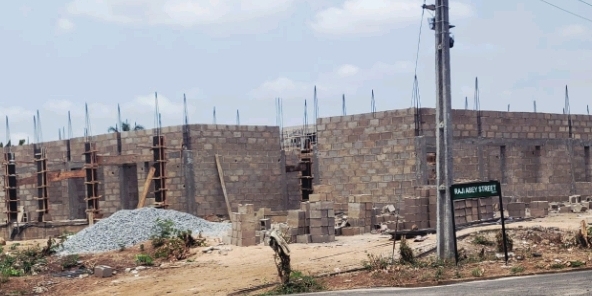
Residential area illegally turned commercial
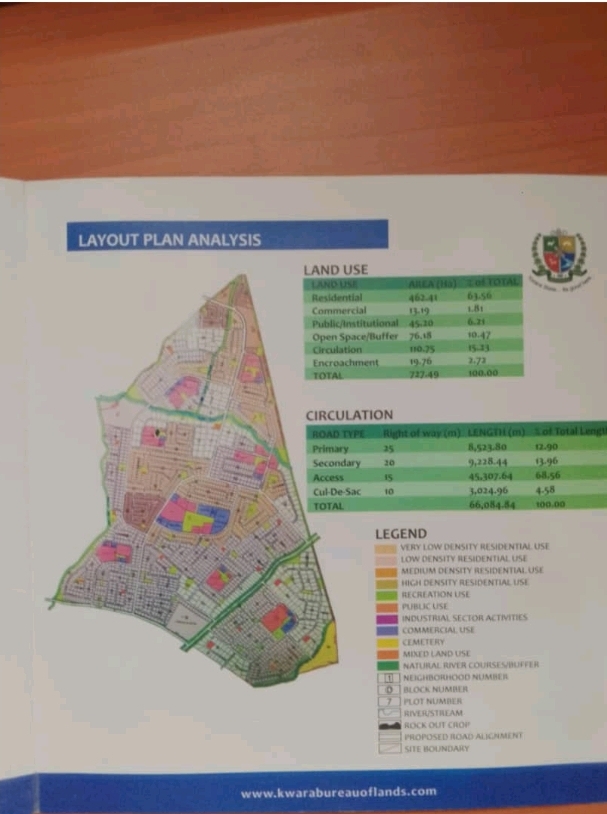
One of the selling points of New GRA Budo-Osho was that it would be a properly planned GRA with a well delineated residential areas, religious zones, as well as commercial areas. The layout plan, published by the Bureau of Lands, was meticulous: colour-coded zones for different uses, circulation hierarchies, neighbourhood numbers. It was the kind of plan that inspires confidence. It said: this place will be orderly. It will be protected. The rules will apply to everyone.
They do not apply to everyone.
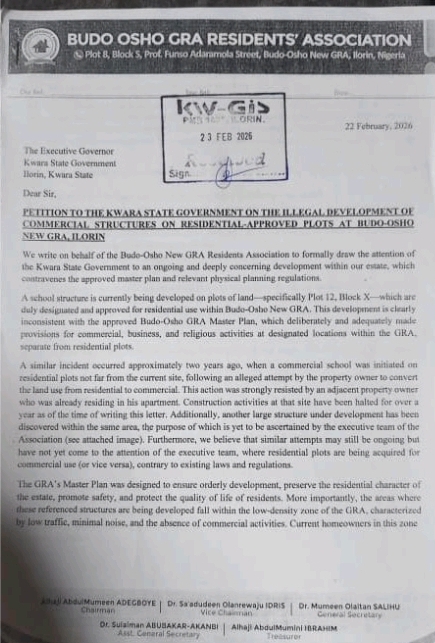
According to Chairman Adegboye, individuals with what he diplomatically describes as “government connections” have been converting residential plots designated and sold exclusively for home construction into commercial ventures. Most visibly, schools are being established on residential land, bringing with them noise, traffic, and the kind of commercial activity that the estate’s zoning laws were specifically designed to prevent.
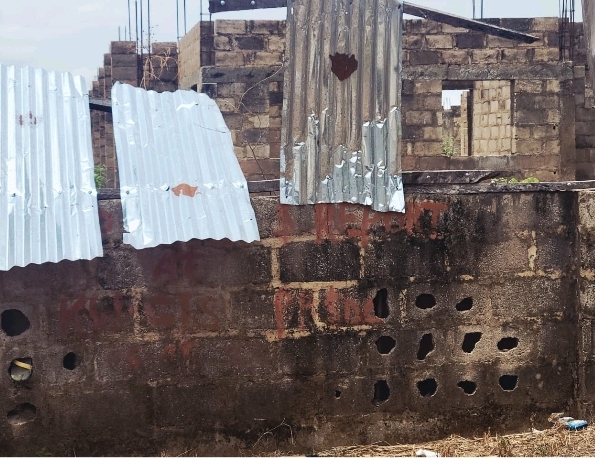
Stopped commercial building in residential plot after the estate association notification
For the residents who bought their plots in good faith, who chose this GRA precisely because it was a planned GRA with enforceable rules, the irony is corrosive. They followed the rules. They paid the right price for residential land and built residential buildings. Meanwhile, those with connections simply ignore the rules, and no government agency has moved to stop them. The planning laws that were supposed to protect everyone protect, in practice, only those who lack the right phone numbers.
“These are people with connections,” Adegboye said. “They do as they please and nobody stops them. The ordinary person who bought land here legally is the one who suffers.” It is a sentence that will sound familiar to anyone who has watched Nigerian governance up close. The rules exist. They are just not enforced equally.
THE PITCH: A WORLD-CLASS DREAM AT ₦100,000 DEPOSIT
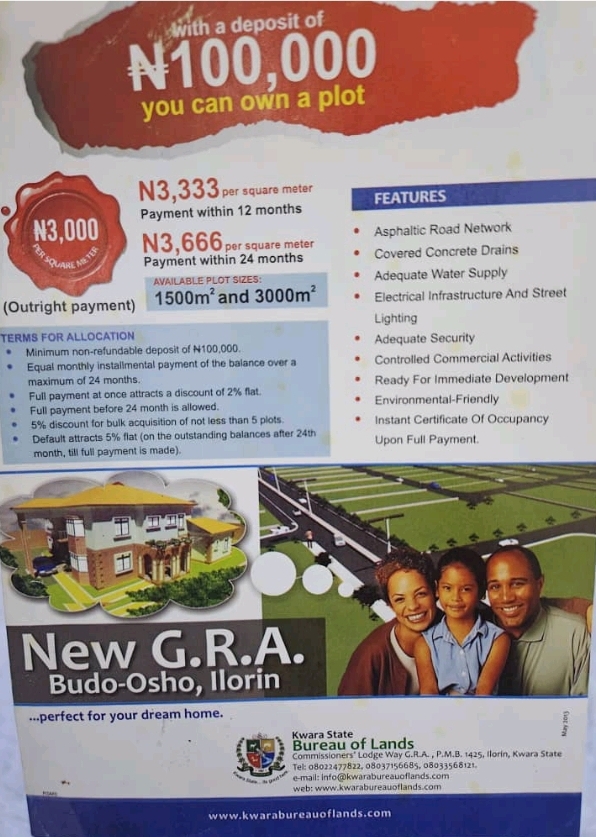
The brochure was beautiful. Glossy, confident, and full of promise, it showed smiling families against a backdrop of well-paved roads, lush landscaping, and elegant homes. “With a deposit of ₦100,000, you can own a plot,” it declared in bold red letters. Beneath that headline was a list of guarantees that would make any aspiring homeowner’s heart race: asphaltic road networks, covered concrete drains, adequate water supply, electrical infrastructure, street lighting, adequate security, and an estate described as “ready for immediate development” and “environmentally friendly.” The Kwara State Government was selling more than land. It was selling a lifestyle.
The New Government Reserved Area at Budo-Osho, in the Tanke axis of Ilorin, was conceived in 2008 under the administration of Governor Bukola Saraki as a bold solution to Ilorin’s rapid urban sprawl. The ancient city was expanding fast, the old GRA was saturated, and a new generation of Kwarans needed modern, planned accommodation. The answer, the government said, was a 710-hectare masterplan a sprawling, self-sufficient residential estate that would rival anything in Nigeria’s most developed cities.
The numbers thrown around by officials were staggering. In October 2011, the Director General of the Kwara State Bureau of Lands, Mr. Tope Daramola, announced that the government would spend ₦25 billion on infrastructure for the GRA. He disclosed that ₦2 billion had already been committed. Roads were being built. Contractors were on site. Original landowners at Budo-Osho village had been paid ₦100 million in compensation. Everything, it seemed, was moving. By January 2012, Mr. Daramola was telling prospective plot buyers to begin developing their land immediately; infrastructure, he said, had reached “an appreciable stage of completion.”
Then came the crowning moment. On May 29, 2013, Governor Abdulfatah Ahmed commissioned the New GRA in a ceremony that made the front page of The Herald newspaper. It was official. The estate was alive. The dream had been handed over.
What nobody told the hundreds of Kwarans who had already paid their deposits many of them life savings was that this commissioning ceremony would mark not the beginning of fulfilled promises, but the end of the government’s interest in the project entirely.
“They sold us a dream, collected our money, commissioned the estate with fanfare — and then disappeared. We are completely on our own.” — Alhaji Mumeen Adegboye, Chairman, New GRA Budo-Osho Residents Association
EIGHT STATIONS. ZERO TRANSFORMERS. A COMMUNITY IN THE DARK.
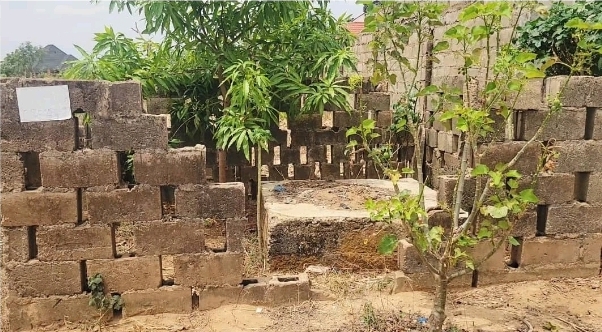
There is something almost theatrical about the electricity situation in New GRA Budo-Osho. Walk the GRA and you will find them: eight transformer stations, solid structures of concrete and metal, built by government contractors at considerable public expense and placed strategically across the GRA’s layout. They look, from a distance, like progress. They look like a government that meant what it said.
“They were transformers here before, but they were never connected to the power grid. Later, government officials came and removed them, citing security concerns. Since then, nothing has been done to replace them.
We have written several letters to the relevant authorities, appealing for the installation of transformers, but there has been no response. In December 2025, when the current administration began distributing transformers to some communities, we made fresh efforts and even got our request considered at a point. Unfortunately, our name was removed at the final stage”- said by the Chairman of the community.
If you come closer, you will see the reality for yourself. Not one of the eight transformer stations in this estate is functional. They are just empty structures—the skeleton of an electricity system that was promised but never delivered. Since the GRA was commissioned, residents have lived without public power supply, relying instead on generators and, more recently, solar systems. The burden—financial and emotional—has been left entirely on the people who bought into the government’s promise
Then there are the streetlight poles. These, at least, were installed. They line the roads of the GRA , standing at their intervals the way streetlights are supposed to stand except they have never been connected to any power source. For years, they stood as silent, useless symbols of what this GRA was supposed to be. Now, many of them are gone entirely. Thieves, emboldened by the absence of any functioning security or government presence, have been systematically dismantling and carting them away in the night. What the government failed to power, criminals have simply taken.
The GRA residents association has written formally to the Kwara State Ministry of Energy about this crisis. They have documented the failed transformer stations, the vandalised streetlight poles, the nightly darkness that engulfs a community that paid for light. The monitoring team from the ministry of energy visited the community in the mid of 2025 for inspection of electrical infrastructure in preparation for the award of transformer to the New GRA in response to one of our letters.. A memo was rasied for this purpose from the ministry of energy to the Government house for approval but we are yet to see positive response from the relevant quarter that will put a lasting solution to the issue of electricity bedeviling the New GRA. The letters, like so many others, appear to have vanished into the indifferent machinery of government.
“Eight transformer stations. Solid, built structures. Not one transformer in any of them. We paid for electricity. We are living in darkness.” — Estate resident, New GRA Budo-Osho
PROTECTING THEMSELVES: A COMMUNITY THAT BUILT ITS OWN GATES
The government’s brochure had promised “adequate security.” What that was supposed to mean in practicea police post, security personnel, controlled access was never specified. What it has meant in practice is nothing at all.
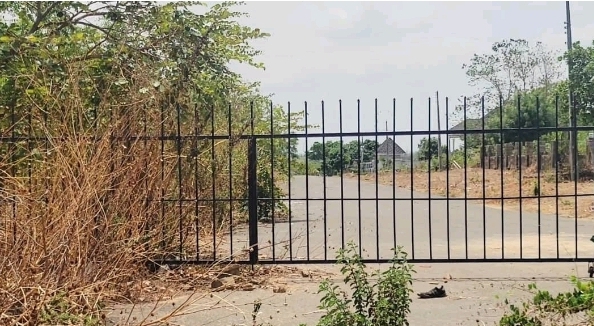
Faced with an estate that sat open and unprotected, the New GRA Budo-Osho Residents Association took matters into its own hands. Residents pooled their money, organised themselves, and funded the construction of gates across all entry points into the estate. The goal was simple: control who comes in and out, deter criminals, and create at least some semblance of the secure environment they had been promised. Every kobo for those gates came from the residents themselves.
“We built those gates ourselves,” the association’s chairman, Alhaji Mumeen Adegboye, said without bitterness, though the effort behind the words was unmistakable. “The government has done nothing for our security. We are protecting ourselves.” It is a sentence that could serve as the motto of this entire GRA, a community that has spent more than a decade doing the government’s job for it, without recognition, without reimbursement, and without thanks.
THE WATER THAT NEVER FLOWED
Drive into New GRA Budo-Osho today and the first thing you notice is the quiet. Not the peaceful quiet of a well-ordered neighbourhood, but the peculiar quiet of a place that has been left to fend for itself. The roads some of them, at least are there. The plots are divided. Some houses have been built, their owners making the best of a difficult situation. But look closer and the broken promises reveal themselves one by one, each more dispiriting than the last.
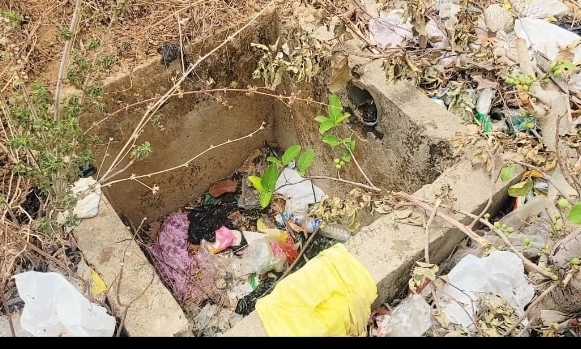
Begin with water. The government’s brochure listed “adequate water supply” as a core feature of the estate. In preparation, a contractor dug a manhole part of the planned water distribution infrastructure and then left. The manhole has sat there, unused and unconnected, ever since. Not a single drop of government-supplied water has ever flowed into any tap in New GRA Budo-Osho.
The consequence has been felt in every resident’s pocket. Every single household in the estate has been forced to drill its own private borehole. In a fully serviced estate, this would have been unnecessary. Here, it is a matter of survival. Residents have spent hundreds of thousands of naira each, duplicating infrastructure that the government was paid, in part, to provide. And they have done so without complaint, because complaining, as they have learned, changes nothing.
The irony is almost too painful to state: those glossy brochures, the ones that promised “adequate water supply,” still exist. They are still being circulated. Somewhere in the files of the Kwara State Bureau of Lands, the promise is still there in black and white, red and gold untouched, unhonoured, and unashamed.
THE GROUND BENEATH THEIR FEET: SAND, SCOOPED AND SOLD
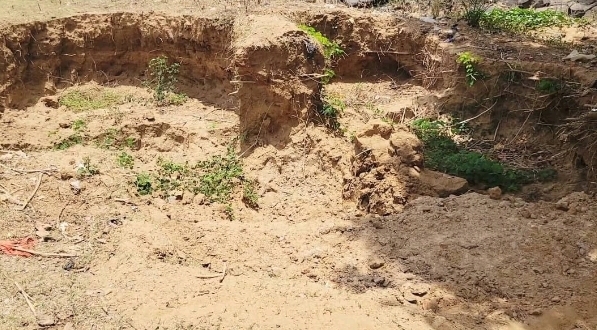
The most chilling account of what is happening in New GRA Budo-Osho comes from the estate association’s General Secretary, Olaitan Salihu. His voice is measured, his words precise, but the alarm in what he describes is unmistakable.
Across the GRA, on undeveloped plots owned by residents who have paid for their land but not yet built on it, tipper trucks have been arriving. They come, seemingly at will, with no authorisation, no permission from the plot owners, and no sanction from any government agency. They dig. They scoop the sand. They load it onto their trucks and they drive away, selling it commercially. Then they come back and do it again.
This is not merely theft, though it is that too. It is, according to Salihu, an environmental hazard of the most serious kind. “The type of excavation happening here could cause ground subsidence,” he said. “What people call minor earthquakes. The structural integrity of this entire neighbourhood is being threatened by what these tippers are doing.” When soil is removed from beneath and around buildings at scale, the ground can shift, settle, and crack. Foundations can be compromised. In a worst-case scenario, the damage can be catastrophic.
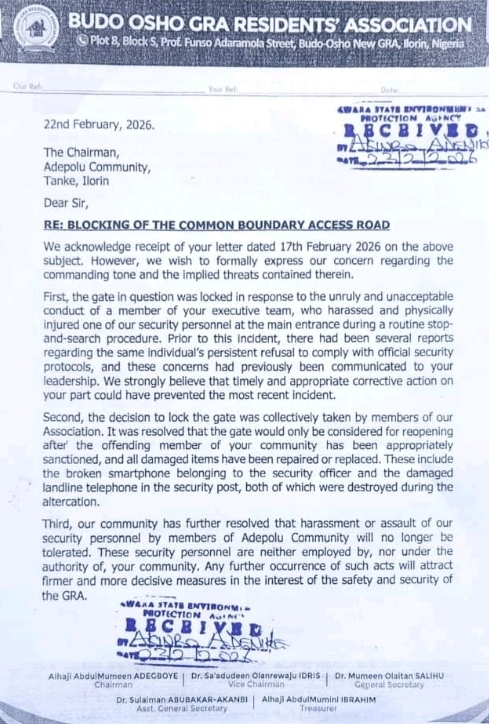
The association has reported the illegal dredging to their own leadership (Tipper Association, Tipper Garage Chapter, Tanke), to the Police Command, F Division, Tanke, Ilorin and to relevant state agencies. They have done everything right. Nothing has happened. The tippers continue to operate. The ground continues to be excavated. And the residents of New GRA Budo-Osho wait for a response that has not come, hoping that the earth beneath their homes holds long enough for someone in authority to notice.
“They are scooping sand from our land like it belongs to them. This could cause the ground to collapse. We have reported everywhere. Nothing happens.” — Olaitan Salihu, General Secretary, New GRA Budo-Osho Residents Association
REFUSE, ROT, AND THE SILENCE OF KWEPA
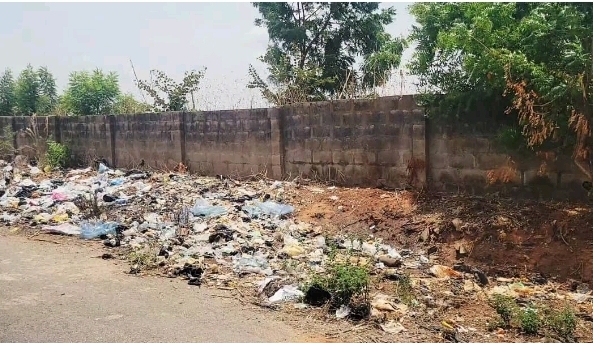
Walk through the less developed sections of New GRA Budo-Osho and you will find yet another indignity heaped upon the residents of this forsaken estate. Large tracts of undeveloped land, land that was supposed to remain green, environmental buffer zones, open spaces designed as part of the estate’s carefully planned 10.47% open space allocation have been converted into dumping grounds. Refuse accumulates. The smell, depending on wind direction, can reach deep into the residential sections.
This is not just an aesthetic problem. It is a public health hazard. Decomposing organic waste, in the rainy season especially, becomes a breeding ground for disease vectors. In an estate built on the promise of being “environmentally friendly,” the irony of refuse mountains growing unchecked within the estate boundaries is almost too cruel to absorb.
The estate association wrote to the Kwara State Environmental Protection Agency (KWEPA) to report the problem and request intervention. KWEPA, which exists precisely to respond to this kind of environmental complaint, did not respond. The governor’s office, which the association also contacted, did not respond. The letters went in. The silence came back. The rubbish remained.
THE PAPER TRAIL: LETTERS WRITTEN, VOICES UNHEARD
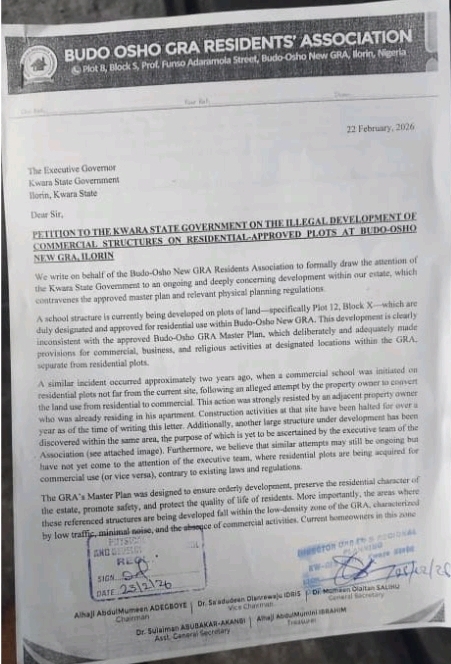
What makes the story of New GRA Budo-Osho more than just a tale of government failure, what makes it a story of institutional contempt is that this community did not suffer in silence. They did not simply grumble among themselves and accept their fate. They organised. They documented. They wrote letters, formal and measured, to the correct departments, through the correct channels, addressed to the correct officials.
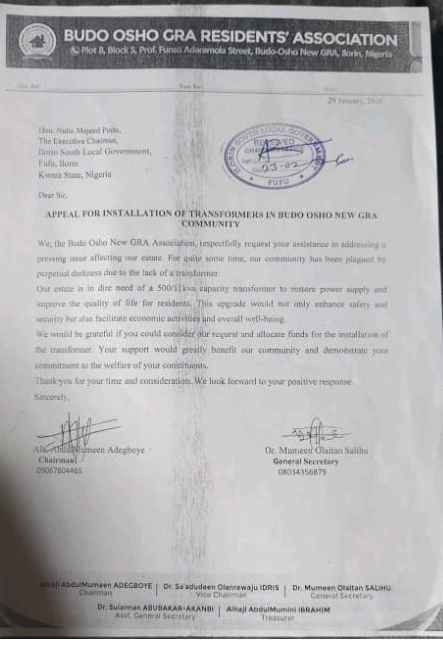
To the Ministry of Energy: letters about the eight empty transformer stations, the unlit streetlight poles, the darkness that greets residents every night.
To KWEPA: letters about the refuse dumps spreading across the estate’s open spaces, the environmental degradation creeping into a community that was sold on the promise of a clean, green neighbourhood.
To the Governor’s office: a comprehensive appeal for intervention, documenting the full litany of unmet promises and deteriorating conditions.
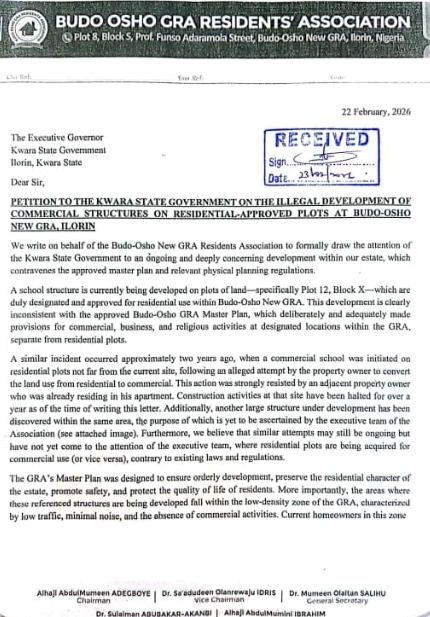
Every letter was sent. Every letter, it appears, was filed and forgotten. Not one has received a substantive response. Not one has led to a government official visiting the estate. Not one has moved a transformer, lit a streetlight, cleared a refuse dump, or stopped a tipper truck.
“We have done everything right,” Chairman Adegboye said, and the quiet frustration in his voice carries the weight of years. “We have written letters. We have gone through proper channels. We have appealed to the governor. The silence from government is deafening.”
It is a deafening silence that speaks volumes about how the Kwara State Government across multiple administrations, across different political colours has come to regard the people of New GRA Budo-Osho. As residents who can be sold a dream. Not as citizens who deserve one.
WHAT THEY ARE ASKING FOR
The demands of the New GRA Budo-Osho Residents Association are not unreasonable. They are not asking for what was never promised. They are asking, simply, for what was promised, paid for, and then withheld.
They want transformers installed in the eight concrete stations that have stood empty for years, so that the GRA can finally have the electricity its residents paid for. They want the streetlight poles repaired or replaced and actually connected to power, so that their roads are not hunting grounds for criminals after dark. They want the government to commission a functional water supply system for the estate, ending the absurdity of an official water scheme that has produced not a single litre of water.
They want enforcement of the estate’s zoning laws, so that the people with political connections cannot continue to build commercial ventures on residential land while ordinary buyers are held to the rules. They want the police and relevant agencies to take seriously the illegal sand dredging that is, quite literally, removing the ground beneath the estate. They want KWEPA to do its job and address the refuse crisis before it becomes a public health emergency.
And above everything else, they want a response. They want to know that the letters they have written have been read by a human being who cares. They want a seat at the table where decisions about the New GRA are made. They want a formal GRA management committee, with resident representation, that holds the government accountable for what it promised.
None of these things should require a newspaper investigation to achieve. In a country where government accountability was working as it should, these problems would have been solved years ago. But this is Nigeria, and this is Kwara State, and so the residents of New GRA Budo-Osho wait, and write their letters, and build their own gates, and drill their own boreholes, and wonder if anyone is listening.
“We are not asking for charity. We are asking for what we paid for. We are asking for what the government promised us in writing, in brochures, in ceremonies.”
A RECKONING OVERDUE
There is a particular kind of betrayal that comes not from malice but from indifference. The Kwara State Government did not design New GRA Budo-Osho to fail. The estate was, at its inception, a genuine and ambitious idea, a planned, modern neighbourhood that would serve the growing city of Ilorin and give ordinary Kwarans access to well-serviced land at reasonable prices. The people who bought plots here were not naive. They were trusting. They read the brochures. They listened to the Director General. They watched the commissioning ceremony. They believed the government.
What they could not have anticipated was that belief, in this case, would be enough. That once the money was collected and the ceremony held, the government would simply move on, treating the estate as a completed project rather than an ongoing obligation. That the people they had sold the dream to would be left to discover, one broken promise at a time, that the dream was a one-way transaction.
More than a decade has passed since Governor Ahmed cut the ribbon at New GRA Budo-Osho. In that time, not a single transformer has been installed. Not a single litre of government water has flowed. Not a single government security arrangement has been made. Every subsequent Kwara State administration has inherited this failure and chosen, apparently, to inherit the indifference along with it.
The people of New GRA Budo-Osho are still there. They are still paying for land, still drilling boreholes, still running generators, still building their own gates, still writing their unanswered letters. They are still waiting for a government that made them a promise and has yet to keep it.
The question is no longer whether that promise was made. The brochures are in print. The speeches are on record. The commissioning ceremony was front-page news. The question — the only question that remains — is whether anyone in the Kwara State Government has the courage, and the conscience, to finally honour it.
The Kwara State Government is yet to respond to all the correspondent requests as at the time of this publication.
The New GRA Budo-Osho Residents Association can be reached through its Chairman, Alhaji Mumeen Adegboye, or General Secretary, Olaitan Salihu.