


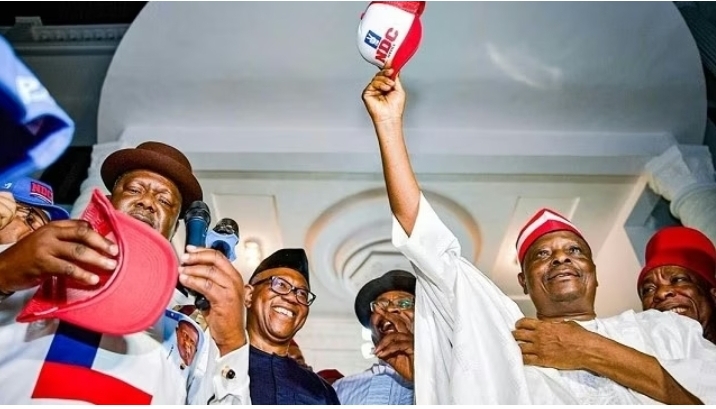
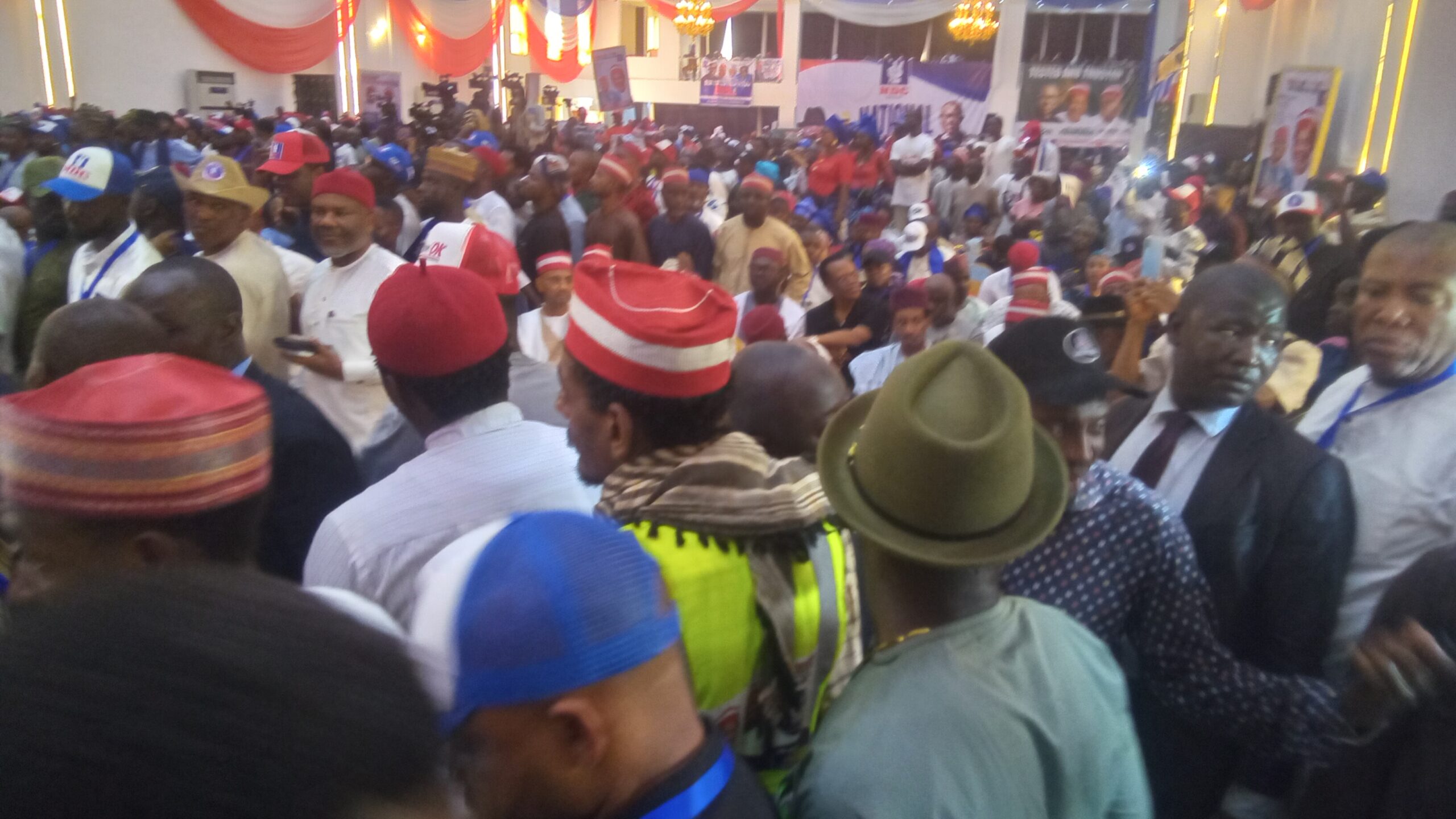
Mammoth crowd of NDC Loualists at the Par5y maiden National Convention at Los Angeles Mall on Saturday in Abuja.
By Abdulrahman Aliagan
Abuja witnessed a major political realignment on Saturday as key opposition figures across Nigeria converged at the maiden national convention of the Nigeria Democratic Congress (NDC), where former Anambra State Governor and 2023 Labour Party presidential candidate, Peter Obi, former Kano State Governor, Rabiu Musa Kwankwaso, and NDC National Leader, Seriake Dickson, jointly declared that Nigeria’s democracy must not be allowed to slide into a one-party state ahead of the 2027 general elections.
The high-profile convention, held in Abuja on Saturday, May 9, 2026, drew delegates, party leaders, political stakeholders, youths and supporters from across the federation, as the emerging opposition coalition formally launched what its leaders described as a nationwide movement to “rescue Nigeria from insecurity, poverty, injustice and bad governance.”
The convention also produced major constitutional and political resolutions, including the formal zoning of the party’s 2027 presidential ticket to Southern Nigeria and the 2031 presidential ticket to the North as part of an agreed rotational arrangement aimed at promoting national balance, inclusion and political stability.
Delegates at the convention further endorsed a four-year rotational presidency framework, which party leaders said would help stabilise the country, reduce regional grievances and strengthen national unity.
The landmark resolutions were adopted after a motion moved by Afam Victor and seconded by Seyi Sowumi during proceedings at the convention.
The convention equally ratified the composition of the party’s National Working Committee (NWC), following a motion moved by Senator Victor Umeh, while amendments were also made to sections of the party’s constitution as part of efforts to strengthen the internal structure and ideological foundation of the NDC.
Earlier in the proceedings, the National Chairman of the NDC formally declared the convention open, charging delegates to remain committed to democratic ideals, national unity and the collective vision of building a credible alternative political platform for Nigerians.
The Chairman of the Convention Planning Committee, in his welcome address, warmly received delegates from across the country and described the gathering as a defining moment in the evolution of opposition politics in Nigeria. He commended party faithful and stakeholders for their commitment to the party’s growth within a short period of its emergence.
In a passionate address that electrified delegates at the convention arena, Obi declared that the NDC represented a platform for “national liberation,” insisting that the opposition would resist every attempt to undermine democracy and credible elections in the country.
Obi, who disclosed that he and his supporters had now become part of the NDC family after political engagements with other opposition platforms, accused beneficiaries of Nigeria’s democracy and judicial system of allegedly turning into agents of democratic destruction.
“Today in Nigeria, we are seeing beneficiaries of democracy, beneficiaries of the judiciary and beneficiaries of good governance turn themselves into agents of destroying democracy and injustice,” he said.
The former presidential candidate commended the leadership of the NDC for insisting that Nigeria must remain a multiparty democracy, warning that any attempt to entrench one-party dominance would be resisted by Nigerians.
“We cannot have one party in Nigeria. Nigeria must have democracy. Those who think there will be no free and fair elections in 2027 should rethink because Nigerians will insist on credible elections,” Obi declared.
Painting a grim picture of the nation’s socio-economic condition, Obi lamented rising insecurity, unemployment and widespread poverty, claiming that over 140 million Nigerians were living in multidimensional poverty while millions of youths remained unemployed or underemployed.
He said many Nigerians now live in fear, uncertain whether family members who leave home daily would safely return.
According to him, Nigeria’s worsening insecurity, hunger and economic hardship were not signs of a poor nation, but evidence of a country “looted into poverty.”
“Nigeria is not poor. Nigeria was looted into poverty, and we are coming to reverse that situation,” he stated.
Obi further said the NDC would focus on moving the country “from consumption to production,” while prioritising national unity, justice, security and economic productivity across all regions.
He also dismissed insinuations that opposition leaders joining the NDC were motivated by political transactions, insisting that the coalition was driven by principles and a shared desire to build a “new Nigeria.”
“We are not changing parties for transactions. We are here because we want to build a new Nigeria that is possible,” he said.
In his keynote address, Dickson described the convention as a historic turning point in Nigeria’s democratic evolution, saying the NDC was founded to preserve multiparty democracy, protect civil liberties and offer Nigerians a credible alternative platform.
The former Bayelsa governor recounted his long political history in opposition politics dating back to 1998, noting that he had consistently resisted intimidation, inducement and political pressure throughout his career.
“In me, you have a hard-boiled opposition operative,” Dickson declared to loud applause from delegates.
He said the political convergence around the NDC would permanently alter Nigeria’s political landscape, stressing that the party was rapidly growing into a national movement.
According to him, millions of Nigerians from across the country had already identified with the party within a few months of its formation because of growing public frustration over governance and democratic decline.
Dickson called on the judiciary, security agencies and the Independent National Electoral Commission to protect democratic rights and guarantee credible elections in 2027.
“We count on all institutions of government to ensure that democratic rights are respected and that free and fair elections are guaranteed,” he said.
Speaking further on the zoning arrangement adopted by the convention, Dickson said the decision to allocate the 2027 presidential ticket to the South and the 2031 slot to the North reflected the party’s commitment to fairness, equal citizenship and national stability.
According to him, the NDC was determined to build a political culture anchored on inclusion rather than domination.
“We want a balanced and stable Nigeria. We do not want a Nigeria of divisions and grievances,” he stated.
He said the four-year rotational arrangement endorsed by the convention would help deepen trust among Nigeria’s diverse regions while reinforcing national cohesion.
Dickson also used the occasion to unveil the ideological direction of the NDC, saying the party intended to evolve into a stable, enduring and principle-driven political institution comparable to enduring political movements around the world.
“We do not want a transactional party that changes arrangement every election season. We want the NDC to outlive all of us,” he said.
The NDC leader particularly appealed to young Nigerians and women to take ownership of the party, describing them as the real beneficiaries and future custodians of the political movement.
Also addressing the convention, Kwankwaso said Nigeria was currently facing one of the most difficult periods in its history due to poor leadership, worsening insecurity and economic hardship.
The former Kano governor said the country had failed to adequately position itself for changing global realities because of governance failures.
According to him, millions of Nigerians had been displaced by insecurity, while investments, education and infrastructure had continued to deteriorate under the weight of poor governance.
“Insecurity has created widows and orphans across the land. Investments are fleeing and the education sector is collapsing,” he lamented.
Kwankwaso, however, said Nigeria’s history showed that national progress often emerged through broad-based political alliances and coalitions.
Drawing references from historical political alliances involving leaders such as Nnamdi Azikiwe and Aminu Kano, he argued that the NDC coalition represented another historic opportunity for national unity and democratic renewal.
He openly backed the party’s decision to zone the presidential ticket to the South, describing it as a step toward fairness, healing and national cohesion.
“This presents a true opportunity for national healing,” Kwankwaso stated.
He added that the NDC would prioritise leadership based on competence rather than ethnic or religious considerations, while working to restore Nigeria’s dignity both locally and internationally.
Party insiders at the convention said the ratification of the National Working Committee and amendments to portions of the party constitution were designed to strengthen internal democracy, clarify party structures and position the NDC as a long-term ideological platform rather than a temporary electoral alliance.
Saturday’s convention ended with chants of “A New Nigeria Is Possible” from party supporters as opposition leaders vowed to intensify mobilisation ahead of the 2027 elections.
The convention is expected to reshape ongoing political realignments across the country as opposition figures continue consultations aimed at building what many observers now see as a formidable coalition capable of challenging the ruling establishment in the next general elections.