


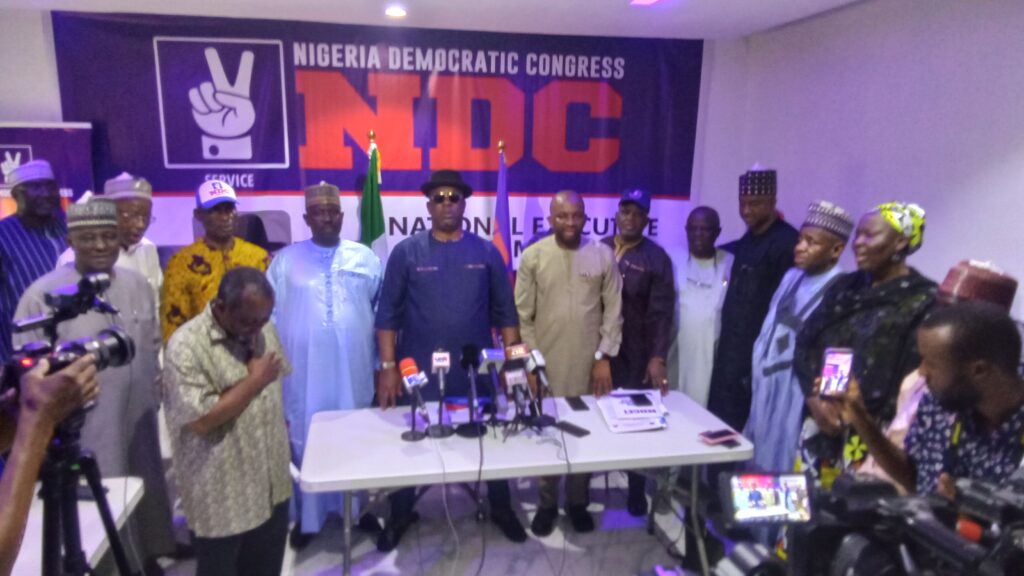
“We do not desire a p⁹olitical party that will last four years, eight years or twelve years. We desire a political institution that can be handed over to the next generation.”
— Senator Cleopas Moses Zuwoghe,
By Abdulrahman Aliagan,
In what may become one of the most talked-about political innovations in Nigeria’s evolving democratic space, the Nigeria Democratic Congress (NDC) has unveiled a policy requiring candidates seeking elective office on its platform to formally commit, through an affidavit, not to defect from the party after winning elections without relinquishing the mandate secured under its banner.
The initiative was unveiled during a press briefing held at the party’s National Secretariat and jointly addressed by the National Chairman, Senator Cleopas Moses Zuwoghe, and the National Legal Adviser, Barrister Reuben Egwuaba.
Party leaders described the initiative as a deliberate institutional response to the growing culture of political defections by elected officials after securing victory under one political platform.
According to the NDC leadership, the move is anchored on the principle of party supremacy, institutional discipline, and the need to build enduring political structures beyond individual ambitions.
Opening the briefing, National Chairman Sen. Cleopas Moses Zuwoghe said the party was determined to create an institution that would survive political cycles and become a lasting democratic platform.
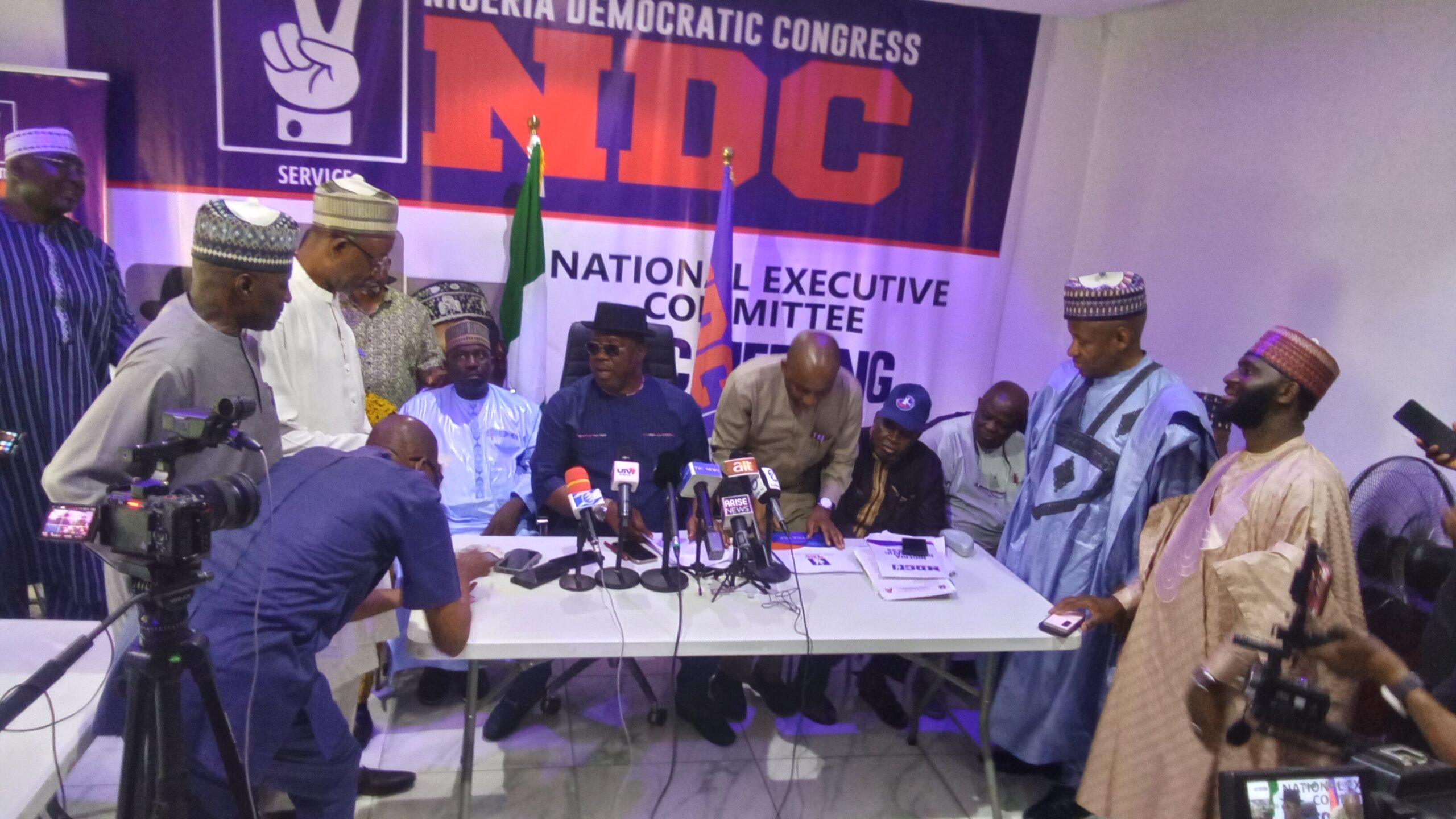
Candidates of NDC signi g and submitting their affidavits during the press briefing in Abuja
“This is not a political party for one man to ride and achieve his ambition and thereafter do whatever he likes with the party.”
He continued:
“We do not desire a political party that will last four years, eight years or twelve years. We desire a political institution that can be handed over to the next generation.”
According to Zuwoghe, one of the recurring challenges confronting Nigeria’s political development has been the ease with which elected officials abandon the platforms that gave them electoral legitimacy.
He argued that political parties should not merely serve as election vehicles but should function as enduring institutions with ideological identity and internal discipline.
Referring to developments across Nigeria’s political landscape, the Chairman noted that defections have weakened party structures and contributed to instability in democratic consolidation.
“You are free to come and contest election under the platform of NDC. Nobody is forcing you. But when you have come and secured our ticket, there are rules by which we guide ourselves.”
He added:
“If you contest election under our platform and win, and later decide to leave, relinquish the mandate upon which you won. Leave with your freedom of association, but drop the mandate because it is a party mandate.”
The Chairman maintained that the policy was not designed to punish dissent or limit constitutional freedoms but to encourage accountability and loyalty to institutions.
Constitutional and Legal Foundation of the Policy
Providing legal clarification, the National Legal Adviser, Barr. Reuben Egwuaba, explained that the affidavit policy was conceived to align with constitutional principles governing political parties and elections in Nigeria.
He argued that political parties occupy a constitutionally recognised role in the democratic process.
According to him, Section 221 of the Constitution of the Federal Republic of Nigeria, 1999 (as amended) provides that: “No association, other than a political party, shall canvass for votes for any candidate at any election…”
He explained that this constitutional provision establishes political parties as the lawful platforms through which candidates seek electoral mandates.
Barr. Egwuaba also referenced Section 222 of the Constitution, which outlines conditions for the formation and operation of political parties and reinforces their institutional character.
“A political party is an association governed by rules and regulations. Participation is voluntary, but once a member subscribes to the party and receives its mandate, obligations naturally arise.”
— Barrister Reuben Egwuaba
The Legal Adviser further acknowledged Section 40 of the Constitution, which guarantees freedom of association and allows citizens to join or leave political parties.
He also cited Article 11 of the African Charter on Human and Peoples’ Rights, which guarantees freedom of association and forms part of Nigerian law.
However, he argued that constitutional freedom does not automatically erase obligations voluntarily accepted under party arrangements.
“Nobody is prevented from changing political affiliation. The question is whether such decision should allow retention of a mandate secured through another platform.”
On legislative offices, Barr. Egwuaba referenced Section 68(1)(g) of the Constitution regarding members of the National Assembly and Section 109(1)(g) regarding members of State Houses of Assembly, both of which provide circumstances under which legislators may lose their seats after defection.
He acknowledged that constitutional debates continue regarding executive offices such as President, Governor and Deputy Governor, where equivalent provisions are not expressly stated.
According to him, the party has addressed that internally through its constitution. He cited Article 15.06 (1), (2) and (3) of the NDC Constitution (as amended), which he said extends the principle of forfeiture across elective positions contested under the party’s platform.
“Irrespective of position—President, Governor, Deputy Governor or any elected office—the party constitution provides that where you voluntarily leave while your tenure subsists, you must relinquish the seat.”
Barr. Egwuaba also referred to judicial principles developed in party nomination disputes and election jurisprudence which recognise the central role political parties play in the electoral process.
Affidavit to Become Part of Candidate Documentation
Under the framework announced by the party, aspirants and candidates will be expected to execute affidavits affirming that where they voluntarily leave the party after securing electoral victory, they will relinquish the mandate obtained under the party.
According to party officials, the affidavit will form part of nomination records and accompany candidate documentation.
“This is not coercion. This is transparency. Every aspirant should understand the conditions before carrying our flag.”
A New Direction in Party Politics?
The NDC leadership insists the initiative is designed to restore ideological commitment, reduce politically motivated defections and strengthen party institutions.
The party recently reaffirmed party supremacy and institutional reforms as part of broader efforts to strengthen internal structures and ensure elected officials remain accountable to the party framework.
Concluding the briefing, Senator Zuwoghe said: “We are showcasing to Nigerians that we are different. We are presenting a political culture built on stronger institutions, better discipline and sustainable democratic values.”
Whether the initiative evolves into a national political model or generates wider constitutional debate remains to be seen. However, the NDC believes it has introduced a conversation that could reshape Nigeria’s democratic culture and redefine the relationship between political mandates and party loyalty.