


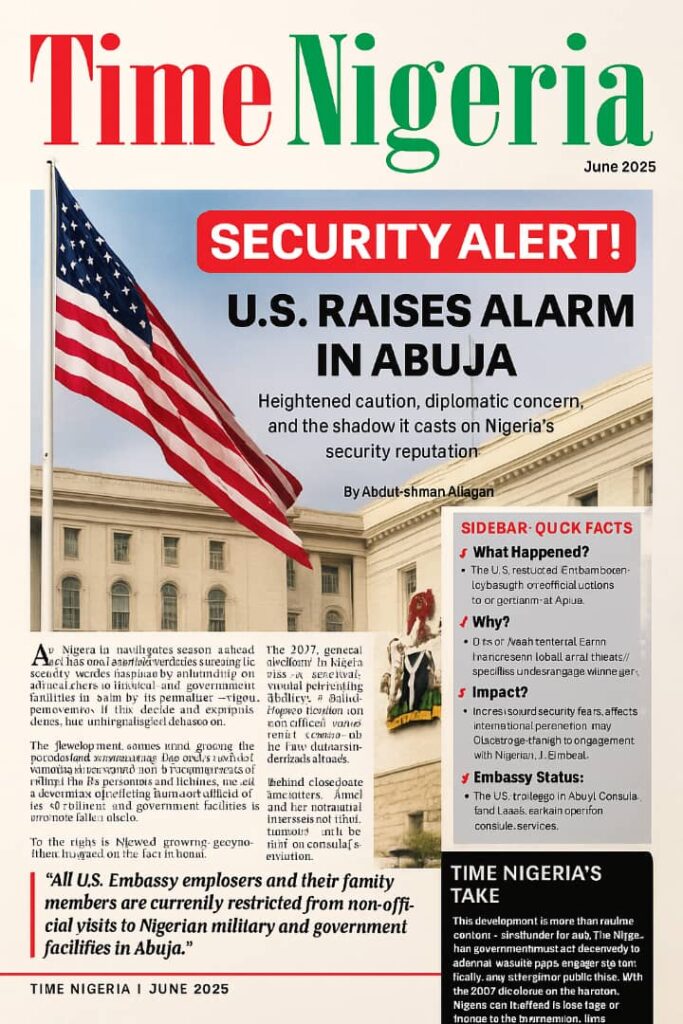
All U.S. Embassy employees and their family members are currently restricted from non-official visits to Nigerian military and government facilities in Abuja,
— US Embassy
By Time Nigeria Editorial Desk
In a move that has sparked renewed debate around Nigeria’s security landscape and international reputation, the United States Mission in Nigeria has issued a stern security advisory warning its citizens against non-official visits to military and government facilities in Abuja. This latest caution—released Sunday—follows a series of growing global and domestic threats, and is being interpreted by analysts as a reflection of the U.S. government’s heightened concern over the security climate in Nigeria’s capital.
According to the statement released by the U.S. Embassy in Abuja, all embassy personnel and their family members are now restricted from visiting Nigerian military or government establishments unless such visits are strictly official. This action, while not unprecedented, signals a more assertive tone in the U.S. government’s posture toward Nigeria’s security management.
“All U.S. Embassy employees and their family members are currently restricted from non-official visits to Nigerian military and government facilities in Abuja,” the embassy said in the advisory, urging American citizens in Nigeria to “exercise a high degree of vigilance.”
Although the advisory stopped short of disclosing specific intelligence or imminent threats, the phrase “heightened caution due to recent global developments” underscores the gravity of the concerns being quietly assessed by diplomatic channels.
Security alerts of this nature are not new to Nigeria, but their consequences are often multi-layered. On the surface, they send a chilling signal to international investors, partners, and NGOs, many of whom calibrate their presence in Nigeria based on such risk assessments. For the Nigerian government, it raises uncomfortable questions about its capacity to secure the Federal Capital Territory and ensure confidence among both local and international communities.
Already, the U.S. advisory has cast a long shadow over diplomatic relations and prompted internal reviews within government circles. According to senior sources, Nigeria’s Ministry of Foreign Affairs is “monitoring the situation closely” and seeking further clarification through diplomatic backchannels.
For ordinary Nigerians, such advisories often reinforce a narrative of insecurity and create ripple effects in travel, economic confidence, and public sentiment. Areas frequented by expatriates, such as Maitama, Wuse II, and parts of Central Business District in Abuja, are seeing increased surveillance and security presence—a development that affects residents and workers alike.
The advisory also includes strong personal safety recommendations to U.S. citizens in Nigeria, including:
Avoiding large gatherings and unnecessary travel
Staying alert in public places
Varying daily routines to avoid predictability
Familiarizing oneself with emergency exits and safety procedures
American citizens were further encouraged to register with the Smart Traveler Enrollment Program (STEP) to receive real-time alerts and critical updates while abroad.
This is not the first time the United States has issued such warnings. In October 2022, the U.S. government issued a similar security alert regarding possible terrorist attacks in Abuja. That advisory led to temporary closure of schools and relocation of some diplomatic families. While no major incident followed, the cautionary posture highlighted how seriously Washington views security gaps in Nigeria.
With Nigeria inching closer to the 2027 general elections, the stakes are high. Political activities are beginning to peak, and any perception of instability could derail national plans and international goodwill. For Nigeria, these advisories must serve as more than warnings—they should act as triggers for real investment in national security infrastructure, intelligence coordination, and global confidence-building measures.
While the U.S. Embassy and Consulate General in Lagos remain fully operational, the message is clear: Nigeria must act, and act fast.
As the world watches closely, it is now up to Nigerian leadership to rise to the occasion—ensuring not only the safety of its citizens and visitors but also the restoration of its standing in the eyes of the international community.