


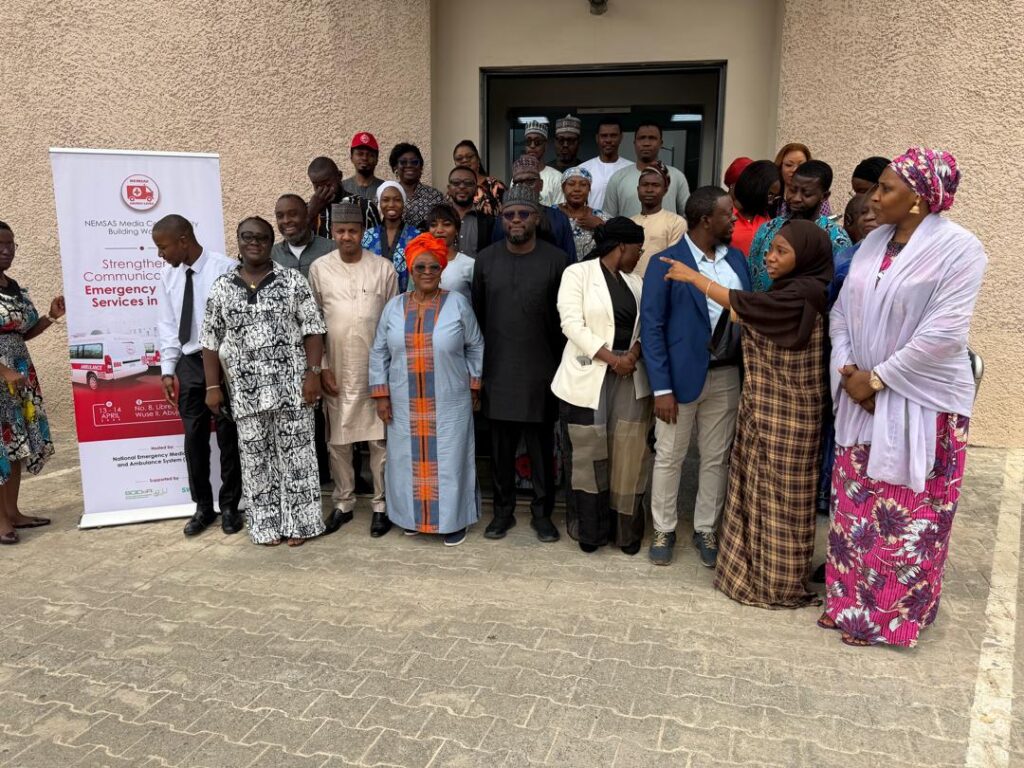

Dr. Chief Mrs Moji Makanjuola, the Executive Director, International Society for Media in Public Health flanked in group photograph with participants at the 2-Day training session organised by NEMSAS in Abuja
By Abdulrahman Aliagan,
In a country where minutes can mean the difference between life and death, Nigeria’s emergency medical response system is grappling with a silent but deadly obstacle—poor telecommunications connectivity.
At a recent media workshop in Abuja themed “Strengthening Communications for Emergency Medical Services in Nigeria,” the National Coordinator of the Nigerian Emergency Medical Services and Ambulance System (NEMSAS), Dr. Doubra Emuren, laid bare the gravity of the situation. According to him, unreliable network coverage continues to cripple emergency call systems and disrupt coordination efforts across the country, particularly in rural and hard-to-reach communities.
“Connectivity is critical to emergency response,” Emuren stressed. “When networks fail, response time is affected, and lives are put at risk.”
Despite the introduction of the national emergency number 112—an initiative coordinated by the Nigerian Communications Commission—its effectiveness remains inconsistent in many regions. Weak integration between telecom providers and emergency response frameworks has further compounded delays, often leaving victims stranded without timely assistance.
The workshop, organised in collaboration with the Solina Center for International Development and Research, brought together stakeholders to examine how communication gaps are undermining Nigeria’s already stretched emergency healthcare system.
Beyond connectivity, the numbers paint an even more troubling picture. Nigeria currently has fewer than 1,000 paramedics—a stark contrast to what is required for a population of over 200 million people. Emuren highlighted the urgent need to expand the training of emergency medical technicians (EMTs), who can provide basic life support and serve as the backbone of pre-hospital care.
“Paramedics handle advanced life support, but what Nigeria urgently needs is a larger workforce trained in basic life support,” he explained, advocating for accelerated EMT training through accredited institutions.
Infrastructure deficits also loom large. With only about 500 functional ambulances nationwide—far below the estimated 4,000 required—the country’s capacity to respond swiftly to emergencies remains severely limited. Emuren called for increased private sector participation to bridge this gap, alongside the integration of air ambulances for rapid response in congested urban centres and remote rural areas.
Yet, the challenges do not end there. Poor road networks, insecurity, and the absence of an effective traffic management system continue to hinder emergency operations. Emuren proposed a national framework that prioritises ambulance movement during crises, as well as the introduction of a “Good Samaritan Law” to protect bystanders who offer first aid from legal repercussions.
Despite these daunting hurdles, NEMSAS has recorded notable achievements. Under the Maternal Mortality Reduction Innovation and Initiatives (MAMII), the agency has facilitated the transportation of approximately 47,000 pregnant women and newborns across 132 local government areas, providing critical support for safe deliveries and timely referrals.
Meanwhile, efforts to reform the broader health sector are underway. Dr. Lawal Bakare of the Sector-Wide Approach (SWAp) Coordination Office at the Federal Ministry of Health and Social Welfare highlighted ongoing initiatives aimed at improving coordination, resource distribution, and access to healthcare services. These reforms align with the National Health Act and are supported by the Nigerian Health Sector Renewal Investment Initiative.
For Moji Makanjuola, Executive Director of the Initiative for Sustainable Media Policy and Health (ISMPH), the media remains a crucial ally in this transformation. She described journalists as a vital bridge between policymakers and the public, capable of translating complex health policies into actionable information and driving accountability.
As stakeholders at the workshop concluded, fixing Nigeria’s emergency response system will require more than just policy pronouncements. It demands a coordinated effort—one that strengthens communication networks, expands workforce capacity, and builds resilient infrastructure.
Until then, the reality remains stark: in Nigeria’s emergency landscape, a dropped call could still cost a life.