



BankingBusinessCover StoryEconomyForeign NewsNews

Nigeria’s Recapitalised Banks Position as Engines of $1 Trillion Economy at London Capital Forum

3 Mins read

With 32 banks meeting new capital requirements and 72 per cent of funds raised domestically, Nigeria’s banking sector emerges from its most significant reform cycle as the primary engine of the country’s capital mobilisation agenda.
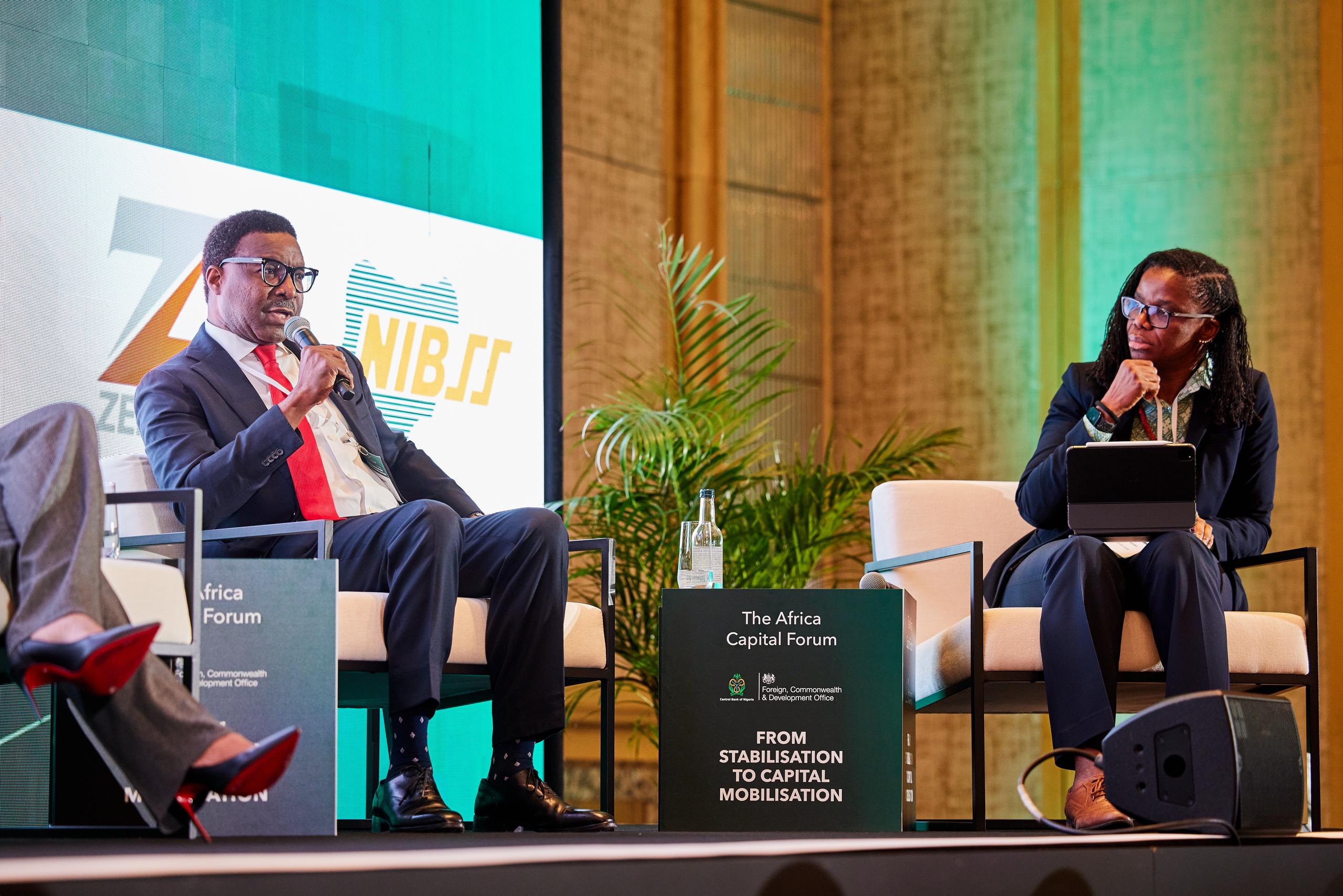
LONDON — When Nigeria’s banking recapitalisation exercise was announced, the debate centred largely on compliance: which banks would meet the threshold, and by when. At The Africa Capital Forum’s inaugural convening in London on Tuesday, the conversation had moved on entirely. The question was no longer whether Nigeria’s banks could recapitalise. It was what a recapitalised Nigerian banking sector could now do for a $1 trillion economy.
The answer, according to the chief executives who gathered at The Peninsula London alongside President Bola Ahmed Tinubu’s UK state visit, is considerable.
Akin Ogunranti, Executive Director of Zenith Bank, set the tone early. “We need to give ourselves credit,” he told delegates. “The fact that over 72 per cent of the capital was raised locally is a major milestone.” That figure carries weight beyond optics. It signals that Nigerian capital markets are deepening, that domestic investors have confidence in the banking sector’s trajectory, and that the foundation for long-term growth is being built from within.

CBN Governor Olayemi Cardoso was direct about what the sector has become. “We are very proud of what the Nigerian banks have been able to accomplish,” he said. “They play a dominant role on the African continent and in the United Kingdom. They are our ambassadors.” Thirty-two banks have now met the CBN’s new capital requirements, and Cardoso described the system that has emerged as categorically different from what preceded it. “The financial system we had is dead and buried. What we have now is a new system that has brought liquidity and transparency.”

The implications for the broader economy were spelled out across the afternoon’s sessions. Yemisi Edun, Managing Director of First City Monument Bank, noted that recapitalisation had directly expanded the credit available to businesses: “The raised capital has created expansion of credits. The new recapitalisation has given more credibility to what we can do as industries.” Segun Alebiosu, Managing Director of First Bank, made the international dimension explicit. “With currency reforms, Nigerian banks will be able to take home bigger transactions. We can do more, and crowd new investments.” He added that Nigerian banks today maintain at least seven operations in the United Kingdom alone.

The scale of Nigerian banking’s continental footprint was perhaps most vividly illustrated by Oliver Alawuba, Group Managing Director of UBA, who noted that over 65 per cent of the bank’s revenue now comes from outside Nigeria. “That means that we can do more in Africa,” he said.
That outward reach is not incidental to the $1 trillion economy agenda. It is central to it. Miriam Olusanya, Managing Director of Guaranty Trust Bank, pointed to the restoration of correspondent banking relationships as a structural shift: “The confidence has been restored and corresponding banking relationships will continue to grow.” Those relationships determine Nigeria’s ability to facilitate cross-border trade, attract foreign investment, and participate in the global capital markets at the scale a $1 trillion economy requires.

Sanyade Okoli, Special Adviser to the President, framed the government’s position plainly: “The government alone cannot fund this growth. We need to work with partners who will bring the sticky, equity capital.” A recapitalised, internationally credible banking sector is how that partnership becomes possible.

Governor Cardoso closed by placing the banking sector’s transformation within its broadest context. “This is perhaps the first time in many years that we’ve had this level of consistent stability,” he said. “And it is likely to stay on course.”

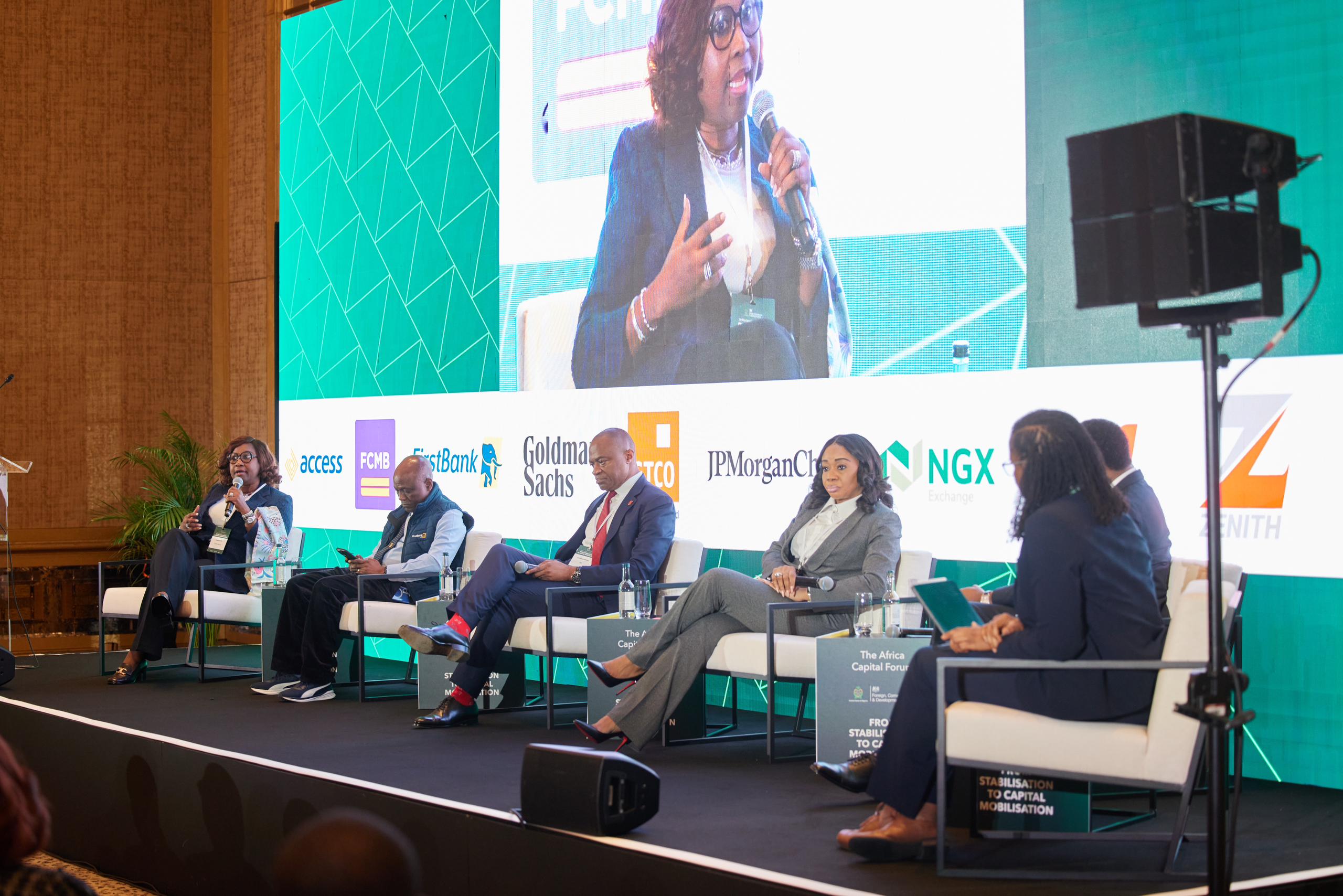
The Africa Capital Forum was convened by the Central Bank of Nigeria in partnership with the UK Foreign, Commonwealth and Development Office and hosted by BBC News Presenter Lukwesa Burak. It was supported by Access Bank, FCMB, First Bank, Goldman Sachs, GTCO, J.P. Morgan, Nigerian Exchange Group, UBA, and Zenith Bank.

The Africa Capital Forum is an independent institutional convening platform dedicated to advancing strategic dialogue on capital mobilisation, financial system development, and investment into Africa. The Forum convenes senior leaders from global financial institutions, development finance organisations, central banks, and the private sector to examine the policy and market conditions shaping Africa’s economic trajectory.

   

About author
Time Nigeria is a modern and general interest Magazine with its Headquarters in Abuja. The Magazine has a remarkable difference in editorial philosophy and goals, it adheres strictly to the ethics of Journalism by using the finest ethos of the profession to promote peace among citizens; identifying and harnessing the nation’s vast resources; celebrating achievements of government agencies, individuals, groups and corporate organizations and above all, repositioning Nigeria for the needed growth and development. Time Nigeria gives emphasis to places and issues that have not been given adequate attention by others. The Magazine is national in outlook and is currently being read and patronized both in print and on our vibrant and active online platform (www.timenigeria.com).
Articles
Related posts
All The NewsCover StoryNewsPolitics

Musa Tsoken Congratulates Kalu on Daily Times’ Lawmaker of the Year Award

1 Mins read
The National Coordinator of the Asiwaju Again Renewed Hope Support Initiative 2027 and National President of the APC Initiative for Good Governance…
Abuja FileDevelopmentEconomyEnergyFinanceInside LagosOpinionPerspective

The Missing Middle of Infrastructure Finance: Why Capital Still Fails to Become Infrastructure

6 Mins read
  By Chidi Nwafor  In October 2023, a Gulf sovereign wealth fund quietly closed a $2 billion allocation to global infrastructure, earmarked in part for emerging-market energy and transport assets. The announcement drew the usual applause: another sign, commentators said, that institutional capital was finally waking up to the infrastructure opportunity in the Global South. Eighteen months later, less than a tenth of that allocation had actually left the fund’s balance sheet. Not because the mandate had changed. Not because the fund had lost appetite. According to two people familiar with the portfolio, the constraint was simpler and more uncomfortable: there were not enough investable projects to put the money into. This is not a story about a reluctant investor. It is a story about capital that wants to move, cannot find enough places willing and able to receive it in a form it can underwrite, and quietly waits instead. Multiply that fund by the hundreds of pension schemes, sovereign wealth vehicles, commercial banks and infrastructure funds now carrying dedicated allocations for emerging-market infrastructure, and a pattern emerges that rarely makes it into a headline: the world is not short of capital for infrastructure. It has capital in historic abundance, sitting adjacent to a historic infrastructure gap, unable to cross the distance between the two. The Comfortable Explanation  The explanation on offer at every major infrastructure summit is a familiar one. Global infrastructure investment needs run into the tens of trillions of dollars over the coming decade; committed capital falls well short; therefore, the problem is one of insufficient funding, and the solution is more of it: more pledges, more blended-finance facilities, more climate funds, more multilateral capital increases. It is a comfortable explanation because it assigns responsibility clearly to governments who under-fund, institutions who under-commit, and it offers a clean remedy: raise more. It is also, on close inspection, not what the evidence shows. Pension funds globally hold trillions in assets under management with explicit infrastructure allocations that remain structurally underweight, not because trustees have rejected the asset class but because deal flow meeting their risk and governance thresholds has not materialised at the pace their mandates assume. Sovereign wealth funds report the same pattern. Commercial banks with dedicated project finance desks describe pipelines that look full at the term-sheet stage and thin dramatically by financial close. Development finance institutions, whose entire purpose is to absorb risk that commercial capital will not, routinely report that their binding constraint is not capital adequacy but the volume of bankable transactions their teams can originate and structure in a given year. None of this fits the scarcity narrative. All of it fits a different one. Availability Is Not Deployability  Capital availability and capital deployability are not the same condition, and the conflation of the two is doing real damage to how the world thinks about the infrastructure gap. Availability asks whether money exists somewhere with a mandate that could, in principle, be pointed at infrastructure. Deployability asks something much narrower and much harder: whether a specific project, at a specific moment, has been engineered, structured, documented and de-risked to the point where an investment committee can approve it without exception. The first condition is met, overwhelmingly, across nearly every category of capital that matters to infrastructure. The second is met by only a small fraction of the projects competing for it. The result is a market that looks, from the outside, like a financing gap, and functions, from the inside, like a conversion problem: an abundance of capital on one side, an abundance of infrastructure need on the other, and an underbuilt set of mechanisms in between capable of turning one into the other at any meaningful scale. Where the Conversion Breaks  The break does not happen at the ends of the process. It happens in the middle, in the unglamorous sequence of work that turns a plausible concept into an instrument a fiduciary can sign. A promising transmission project needs a feasibility study rigorous enough to survive institutional scrutiny rather than optimistic enough to attract early interest. It needs offtake arrangements that hold up under real counterparty and currency risk, not the counterparty risk assumed in a base case. It needs environmental and social documentation calibrated to the standards of the institutions being asked to fund it, not the standards of the jurisdiction hosting it. It needs a legal and commercial structure that allocates risk in ways a commercial lender, not only a development financier, will accept. It needs a sponsor capable of executing what has been proposed, not merely capable of proposing it. Each of these is ordinary project finance discipline. None of it is exotic, and in mature infrastructure markets it happens as a matter of course, absorbed into systems built over decades: specialist advisers, standard-form contracts, established procurement norms, deep pools of transaction expertise. What is missing in the markets where the infrastructure gap is largest is not the standard itself but the machinery that meets it. Projects arrive at investment committees with ambition intact and preparation incomplete, and that gap is treated, again and again, as an individual project’s failure rather than what it actually is: a structural absence in the systems responsible for producing investable transactions at scale. The Missing Middle  This is the Missing Middle of Infrastructure Finance: the institutional architecture that sits between capital that wants to move and infrastructure that needs building, and whose incompleteness explains far more of the global infrastructure gap than any shortfall in committed funds. It consists of project preparation facilities able to fund feasibility and structuring work before commercial viability has been proven. Transaction advisers capable of building deals that satisfy development mandates and commercial return thresholds at once, rather than treating the two as separate constituencies to be managed sequentially. Risk-sharing and guarantee instruments that convert political, regulatory and currency risk into something a commercial balance sheet can underwrite. Aggregation platforms that bundle smaller, individually sub-scale projects into portfolios large enough to justify institutional transaction costs. Standardised documentation that reduces the bespoke legal cost of every new deal. And coordination across ministries, regulators and financiers robust enough that a technically sound project does not die in bureaucratic sequencing after the money has already been found. None of these are new ideas in isolation. What is missing is their assembly into a coherent system, deliberately funded and institutionally accountable, rather than scattered across donor-funded pilots that end when the grant does. The African Dimension  Africa makes this dynamic unusually visible, and consequently offers an unusually clear opportunity to correct it. The continent’s infrastructure financing need, by any measure, is vast. Less understood is that the shortfall is disproportionately one of preparation rather than capital. Nigerian gas-to-power, off-grid solar and mini-grid developers have each demonstrated that individual projects can clear the bankability bar; what has not emerged is systemic pipeline scale, a steady stream of comparably prepared projects large enough to absorb the capital already circling the sector. The pattern repeats, with local variation, from grid infrastructure in East Africa to transport corridors in West Africa. Interested capital is rarely the scarce input. Investment-ready projects are. The Global Comparison  Mature markets solved this problem gradually and mostly invisibly, through decades of institution-building that predates the current infrastructure conversation: specialist project finance units inside banks, standardised PPP frameworks, established regulatory playbooks, deep benches of transaction lawyers and engineers who move between deals rather than between one-off assignments. Emerging and frontier markets are not being asked to meet a lower standard. They are being asked to meet the same standard without having built the same machinery, and then being told, when deals fail to close, that the problem is insufficient funding….
Cover StoryNewsSports

Union Bank, AIICO Multishield, Checkers Custard, Others Back 5th Cycling Lagos

2 Mins read
Union Bank of Nigeria Plc, AIICO Multishield, Checkers Custard and other corporate organisations have thrown their weight behind the 5th Cycling Lagos,…
Stay on the loop!

Subscribe to our latest news.

Leave a Reply

WP2Social Auto Publish Powered By : XYZScripts.com