


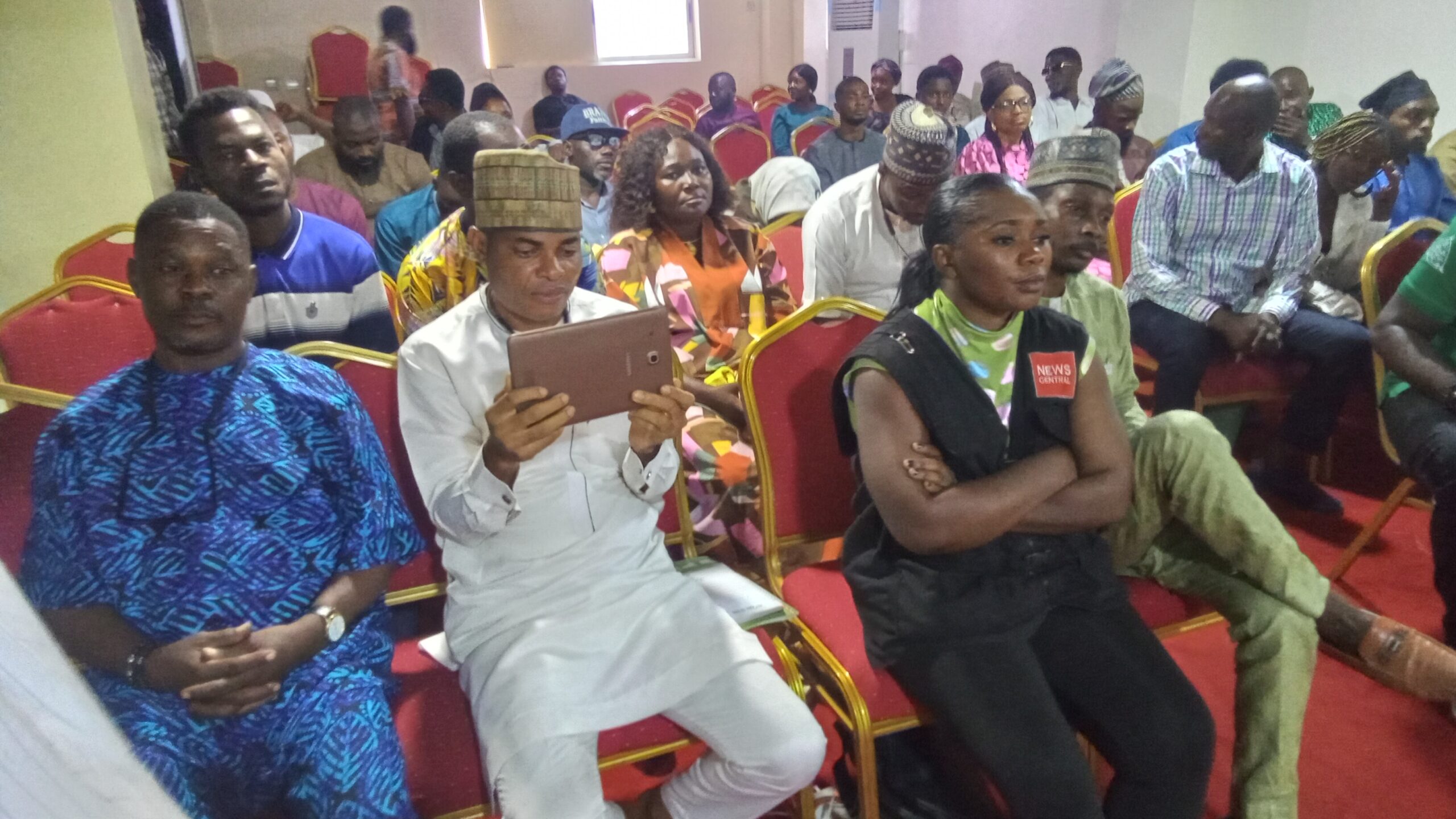
Participants at I-Vote Movement yesterday in Abuja
By Abdulrahman Aliagan, Abuja
With less than two years to Nigeria’s next general election, a powerful political current is rising from the grassroots and threatening to shatter the longstanding grip of establishment politics. That movement is the I-Vote Movement 2027—a people-centred coalition of angry but organized citizens, tired of recycled promises, elite-driven reforms, and government that speaks more to global financiers than to hungry, displaced, and jobless Nigerians.
Born out of frustration, nurtured by shared suffering, and driven by a vision for a new Nigeria, the I-Vote Movement is quickly becoming more than a hashtag or civil society campaign. It is shaping into a formidable political tsunami—and it has set its sights on the 2027 general elections with one clear goal: to shake the table of the ruling All Progressives Congress (APC) and dismantle politics as usual.
“Are You Better Than You Were Two Years Ago?”
This is the question that echoed loudly during the Press briefing that unveiled the I-Vote Movement in Abuja Thursday. And it is not just a rhetorical jab—it is the opening salvo in what appears to be a mass rebellion against the economic missteps, inflationary policies, and leadership failures of the APC-led administration.
According to Comrade Ishaya Inuwa Darkwa, National Coordinator of the I-Vote Movement, the current administration under President Bola Ahmed Tinubu has delivered nothing close to the “Renewed Hope” it promised in 2023. Instead, Nigerians have been handed a brutal cocktail of economic suffocation, policy chaos, and social decay.
“A litre of petrol that cost ₦11 in 1999 now sells for over ₦700. The naira, once at ₦80 to the dollar, now hovers around ₦1,528. Inflation is soaring above 22%, with food inflation crossing 40%. Over 133 million Nigerians live in multidimensional poverty. These are not just numbers; they are lived traumas,” he declared, drawing murmurs of agreement from a visibly charged audience.
Unlike traditional parties that rely on billion-naira campaign war chests, rented crowds, and media spin, the I-Vote Movement is presenting a revolutionary model for political engagement. It is not built around personality cults or ethno-regional strongholds—it is built on issues. It is drawing strength from the pain of the common man, from the disillusionment of youth, and from the determination of Nigerian women who bear the brunt of a broken system.
In Darkwa’s words:
“This movement is not powered by politicians but by reformers—visionaries, grassroots organisers, policy thinkers, street educators, and everyday Nigerians. This is a revolution of conscience.”
This is a direct dig at the ruling class, particularly the APC, which has positioned itself as the saviour party but whose tenure has increasingly shown signs of being out-of-touch with the daily realities of its citizens. The simultaneous removal of fuel subsidy and floating of the naira—with no functional social safety nets in place—caused immediate economic earthquakes: tripled transport fares, mass school dropouts, widespread hunger, and shuttered businesses.
What makes the I-Vote Movement a real threat ahead of 2027 is not just its passionate rhetoric, but its strategy.
The group is already activating state-level structures, building grassroots alliances, and collaborating with other like-minded movements, such as the New Nigeria Initiative and defunct Alliance for New Nigeria. With a plan to embed young leaders and women at every level of decision-making, the movement is bypassing the tired playbook of big man politics. Instead, it is building a platform of service, participation, and people-first policies.
“We will transcend party lines and ethnic identities. We will work with anyone—regardless of their background—who is genuinely committed to the transformation of our country,” said Comrade Da Sam Odeli, the movement’s national field coordinator.
Political analysts say this is where the ruling APC should be concerned. The APC came to power in 2015 on the back of a grassroots wave of dissatisfaction with the People’s Democratic Party (PDP). Today, that same dissatisfaction is mounting—only this time, it’s the APC on the receiving end.
The Tinubu administration’s gamble with economic reforms has created more pain than progress. The floating of the naira, for instance, was hailed by the IMF and foreign investors—but devastated import-dependent SMEs and triggered runaway inflation. Civil servants, teachers, and health workers in several states have not been paid for months, while unemployment and underemployment continue to balloon.
To add insult to injury, President Tinubu recently faced national backlash for offering scholarships to students in Saint Lucia while public schools in Abuja and many states remain closed due to strikes and unpaid wages.
“This is not leadership. This is negligence at its peak. It is an act of betrayal against the Nigerian child,” said Peter Obi, Labour Party’s 2023 presidential candidate, echoing public outrage.
These developments have created the perfect storm—fertile ground for a new, ideologically driven movement like I-Vote to take root and blossom.
Nigeria’s population is 70% youth. And the youth are angry. Angry at failed promises. Angry at unemployment. Angry at police brutality. Angry at a system that works only for the connected few.
The I-Vote Movement is channelling that rage into something powerful: a structured, nation-wide voter revolution. One that doesn’t just protest on Twitter, but registers to vote. One that doesn’t just trend hashtags, but organises at polling units.
“To the Nigerian youth, to every woman who bears the burden of a failing system: this is your moment. This is your call to action,” Darkwa declared.
As the ruling APC braces for 2027, it will not only face its traditional rival, the PDP. It must now contend with a rising tide of civic-minded, voter-driven movements like I-Vote, who are not interested in power for power’s sake but are committed to redefining Nigeria’s leadership contract.
This is not business as usual. The I-Vote Movement is drawing its battle lines not on the basis of tribe or faith—but on the question that will dominate the 2027 ballot:
If the APC cannot convincingly answer that question in the affirmative, then 2027 may not just be another election. It may be Nigeria’s reckoning.
Editor’s Note:
This is part of a continuing series on emerging political movements and Nigeria’s path to 2027. Follow us for more investigative and feature reports on the changing political landscape.