


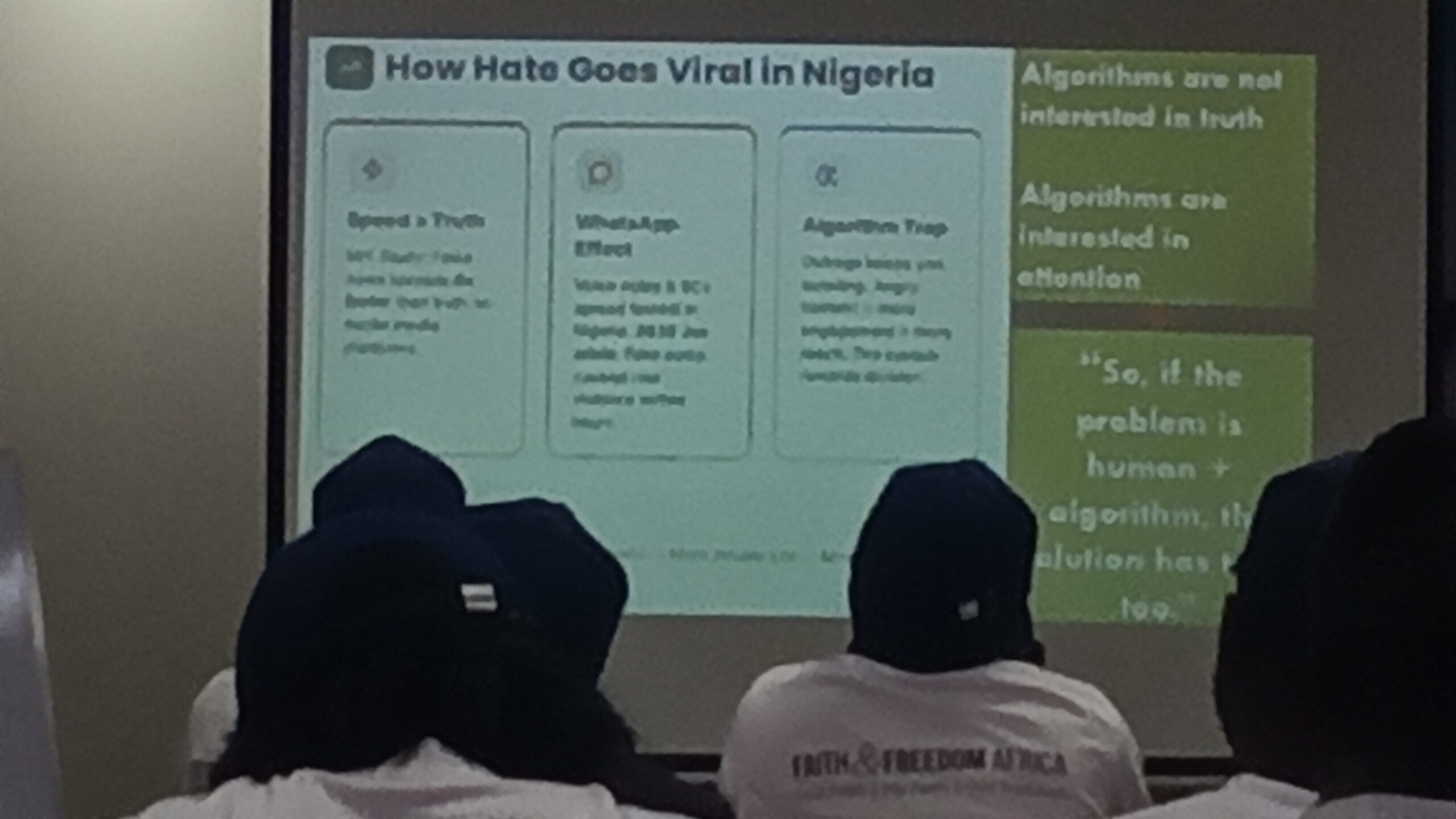
Participants during training facilitation at the Religious Freedom Youth Advicacy Cohort, held in Novare Center, Zone 5 in Abuja.
By Abdulrahman Aliagan,
At a time when religious misunderstanding, stereotypes, misinformation, and identity-based tensions continue to challenge social cohesion in many parts of Nigeria and Africa, a new generation of young advocates is emerging with a commitment to promoting peace, tolerance, and mutual respect.
This vision came alive at the Religious Freedom Youth Advocacy Cohort organised by Faith and Freedom Africa (FFA) at the Novare Central Mall (Novare Centre), Zone 5, Abuja. The programme brought together young leaders, faith actors, civil society advocates, and development practitioners to deepen their understanding of Freedom of Religion or Belief (FoRB) and equip them with practical advocacy skills for promoting peaceful coexistence in their communities.
The event formed part of Faith and Freedom Africa’s broader mission of advancing the understanding and protection of Freedom of Religion or Belief as a foundation for peace, democracy, justice, and sustainable development across Africa.
Faith and Freedom Africa envisions a continent where people of all faiths and those who profess no faith coexist peacefully while respecting one another’s dignity, rights, and beliefs. Through advocacy, dialogue, capacity building, and community engagement, the organisation continues to champion religious freedom while preventing faith-based violence and discrimination.
The Abuja cohort reflected these ideals as participants drawn from Abuja, Kaduna, Port Harcourt, Yola, Bauchi, Kano, Kwara, Kogi, Plateau and Nasarawa are engaged in intensive learning sessions, field exercises, panel discussions, and collaborative activities designed to transform them into ambassadors of peace and religious tolerance.
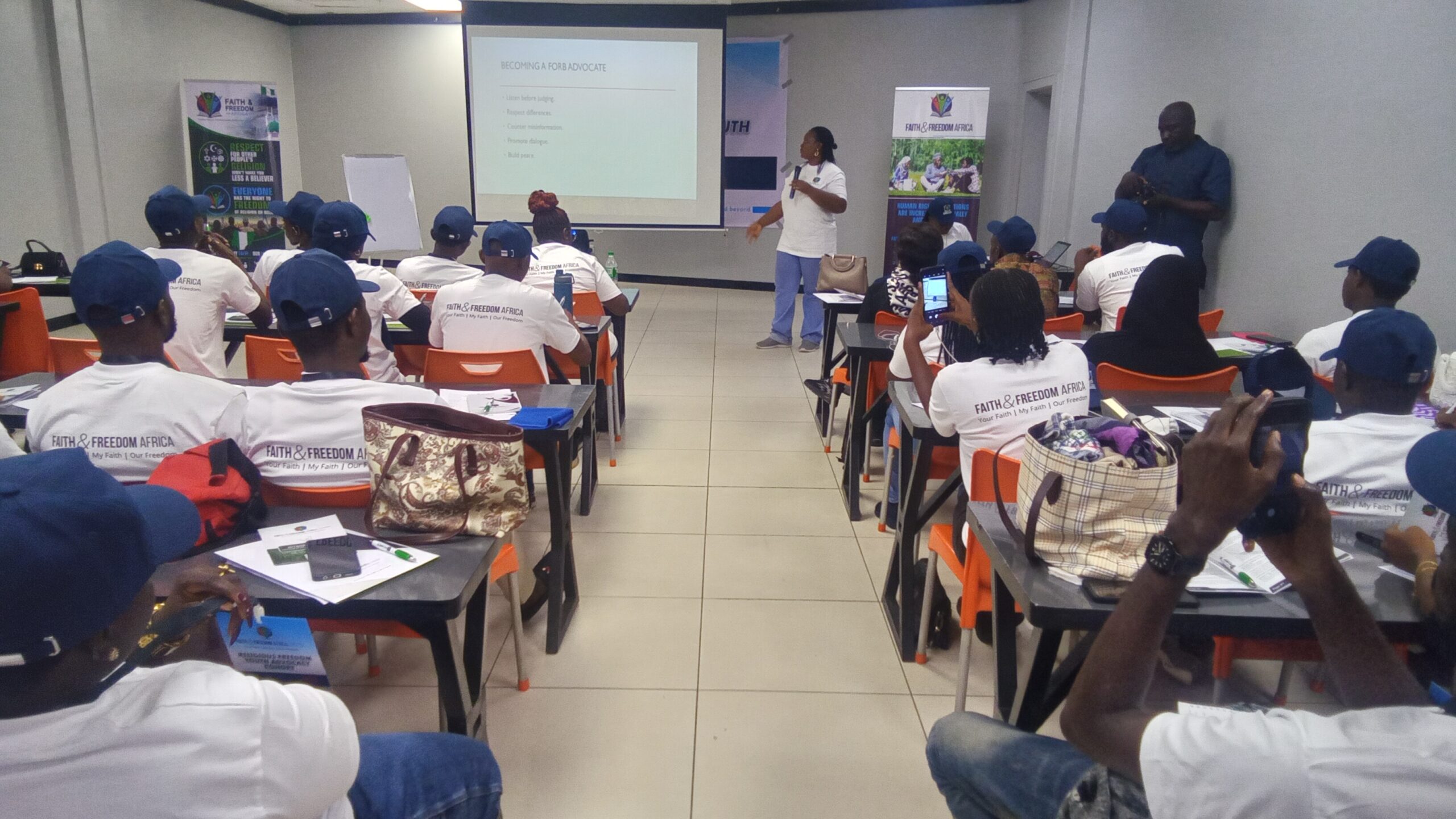
Participants at the cohort held in Abuja
One of the highlights of the programme was the field exercise conducted on the second day of the training. Participants were divided into groups and tasked with observing examples of peaceful coexistence, interviewing individuals involved in interfaith cooperation, identifying indicators of community peace, generating digital content for FoRB advocacy, and reflecting on lessons that could be translated into online campaigns.
The exercise exposed participants to practical realities beyond theoretical discussions. It enabled them to witness firsthand how Nigerians of different religious backgrounds coexist peacefully despite occasional attempts by divisive actors to sow discord.
Through presentations following the exercise, participants shared compelling stories of cooperation among people of different faiths and highlighted the role of dialogue, mutual understanding, and respect in sustaining community harmony.
Their presentations demonstrated a growing awareness that religious diversity should not be perceived as a threat but rather as a source of strength capable of fostering national unity and development.
A major session that resonated strongly with participants was facilitated by Mallam Habeebullahi of the National Mosque, Abuja, who spoke extensively on the subject of Islamophobia and its implications for social cohesion.
Islamophobia refers to prejudice, fear, hatred, discrimination, or hostility directed against Islam and Muslims. It often manifests through negative stereotypes, misinformation, exclusion, stigmatization, and unfair portrayals of Muslims as inherently violent or extremist.
During his presentation, Mallam Habeebullahi challenged participants to critically examine the narratives they consume and share, particularly on social media platforms where misinformation spreads rapidly.
Using practical examples and social media evidence, he demonstrated how biased content, manipulated information, and selective reporting often contribute to negative perceptions of Islam. He explained that many individuals who hold hostile views toward Islam have limited understanding of the religion and frequently rely on distorted narratives rather than authentic knowledge.
The facilitator emphasized that acts of violence committed by criminal elements should not be used to define an entire religion followed by over a billion people worldwide. According to him, extremist groups often exploit religion to pursue selfish political, economic, or ideological interests, while their actions contradict the true teachings of faith.
He urged participants to become responsible digital citizens by verifying information before sharing it online. In an era characterized by fake news, disinformation, and misinformation, he noted that young people have a moral responsibility to ensure that they do not become tools for spreading falsehood or fueling religious tensions.
Mallam Habeebullahi further encouraged participants to become agents of positive change, using social media and community engagement to promote truth, understanding, and peaceful coexistence among people of different faith traditions.
Speaking during the programme, the Country Representative of Faith and Freedom Africa, Mr. Felix Joseph Samari, reiterated the organisation’s commitment to raising a new generation of advocates capable of promoting religious freedom and preventing faith-based violence across Africa.
Samari explained that, “Faith and Freedom Africa was established to advance the understanding and protection of Freedom of Religion or Belief through education, dialogue, advocacy, and community engagement.” According to him, “Religious freedom remains one of the fundamental pillars of democratic societies and sustainable peace.”
He noted that young people occupy a strategic position in shaping the future of Nigeria and Africa, making it essential to equip them with the knowledge, skills, and networks necessary to champion tolerance, inclusion, and mutual respect. He stressed that when youths understand and embrace the principles of FoRB, they become powerful forces for peacebuilding and social transformation.
The FFA Country Representative further observed that many conflicts often thrive on ignorance, stereotypes, and misinformation. He maintained that programmes such as the Religious Freedom Youth Advocacy Cohort help dismantle harmful narratives while creating opportunities for meaningful dialogue among people of diverse backgrounds. According to him, the ultimate goal is to build communities where differences are respected and where every individual can freely practise or express their beliefs without fear of discrimination or persecution.
The programme also provided participants with an opportunity to reflect on their experiences and share lessons learned from the training.
Many participants acknowledged that the sessions had challenged long-held assumptions and encouraged them to view religious diversity from a broader perspective.
Several attendees noted that extremists often manipulate religion to advance personal interests and that such actions should never be mistaken for the genuine teachings of faith traditions.
Others highlighted the importance of social media as a tool for advocacy. They expressed their readiness to use storytelling, videos, digital campaigns, and community engagement initiatives to promote freedom of religion and peaceful coexistence.
A participant remarked that many young people grow up exposed to narratives that create suspicion and mistrust of those from different religious backgrounds. According to her, the training helped participants appreciate the importance of understanding one another rather than judging based on stereotypes.
Another participant emphasized that one cannot effectively protect what one does not understand, noting that the cohort had provided valuable knowledge that would help participants become more effective advocates for religious freedom.
The collective message from participants was clear: Nigeria’s future depends on citizens who are willing to reject prejudice, embrace dialogue, and work together across religious divides.
One of the significant outcomes of the programme was the launch of the FFA FoRB Youth Advocacy Network and WhatsApp Community, designed to sustain engagement among participants beyond the training.
The initiative aims to create a vibrant network of young advocates committed to advancing religious freedom through continuous learning, digital advocacy, community engagement, and collaborative action.
Participants also adopted a set of Youth Advocacy Commitments, pledging to promote religious tolerance, challenge harmful stereotypes, counter misinformation, and contribute actively to peacebuilding efforts within their communities.
The commitments signified a collective resolve to translate knowledge gained during the programme into concrete actions capable of making measurable impacts across Nigeria.
The success of the Religious Freedom Youth Advocacy Cohort demonstrates the growing relevance of organisations such as Faith and Freedom Africa in addressing contemporary social challenges.
By investing in young people and empowering them with knowledge about Freedom of Religion or Belief, the organisation is helping to nurture a generation capable of building bridges where others erect walls.
The enthusiasm displayed by participants throughout the programme reflected a deep appreciation of the vision and mission of Faith and Freedom Africa. More importantly, it showed that younger generations are increasingly embracing the principles of religious freedom, inclusion, dialogue, and peaceful coexistence.
As Nigeria continues to navigate complex social, political, and religious realities, initiatives such as this offer hope that the future can be shaped by understanding rather than suspicion, cooperation rather than conflict, and unity rather than division.
The Religious Freedom Youth Advocacy Cohort was not merely a training programme; it was an investment in peace, an affirmation of human dignity, and a reminder that religious freedom remains a critical foundation for a more harmonious and prosperous society.
For the participants who gathered at Novare Centre, Abuja, the journey has only just begun. Armed with knowledge, inspired by dialogue, and connected through a growing advocacy network, they now carry the responsibility of becoming champions of peace and defenders of freedom of religion and belief in their communities and beyond.