



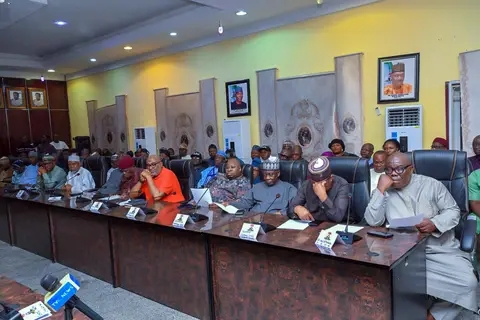
Taraba state All Progressive Congress stakeholders at the crucial meeting at T.Y Danjuma House, Jalingo, Taraba State
In the wake of a high-level stakeholders’ meeting of the All Progressives Congress (APC) in Jalingo, a strong voice has emerged calling for unity and strategic cohesion within the party in Taraba State. Amb. Muhammad Musa Tsoken, though not physically present at the gathering, has issued a compelling message urging party leaders and stakeholders to close ranks as the state prepares for the 2027 general elections.
The meeting, held at the Exco Chamber of TY Danjuma House in Jalingo, brought together key political figures, including the Governor of Taraba State, Agbu Kefas, the Minister of State for Regional Development, Uba Ahmadu Maigari, members of the National and State Assemblies, and influential party stakeholders. While deliberations focused on strengthening the party ahead of its primaries, Tsoken’s intervention from outside the meeting added a critical dimension to the unfolding political discourse.
In a statement released following the stakeholders’ engagement, Tsoken underscored the importance of unity as the bedrock of electoral success. He emphasized that the outcome of the Jalingo meeting must not end in rhetoric but should translate into actionable cohesion among party leaders.
Describing the moment as pivotal, he warned that the conduct of party stakeholders in the coming months would determine whether the APC in Taraba emerges as a formidable force or a fragmented platform heading into the elections.
Though absent from the meeting, his position was clear and unequivocal: the party must stand firm, rise above internal divisions, and present a united front capable of winning the trust of the electorate.
Tsoken’s message placed particular emphasis on subordinating personal ambitions to collective goals. He called on party leaders to engage more deeply with grassroots members, promote consensus where necessary, and ensure that the primary election process is peaceful and inclusive.
To aspirants, his advice was measured but firm—exercise restraint, embrace dialogue, and avoid actions that could deepen divisions within the party. He acknowledged that disagreements are inevitable in political processes but insisted that they must be managed constructively in the interest of party unity.
Referencing the significance of the stakeholders’ meeting in Jalingo, Tsoken urged participants to build on the spirit of dialogue and consultation demonstrated at the gathering. He noted that such engagements should serve as a foundation for stronger collaboration rather than a platform for factional alignments.
He further stressed that any grievances arising from party activities, including recent congresses, must be resolved through internal mechanisms, reinforcing the need for discipline and mutual respect among members.
Central to Tsoken’s intervention is a strategic vision for victory in the forthcoming elections. He advocated for the adoption of consensus candidacy where feasible, describing it as a practical approach to minimizing internal conflict and strengthening the party’s electoral chances.
According to him, unity at this stage is not merely a moral appeal but a political necessity—one that could determine the APC’s ability to compete effectively in Taraba State’s dynamic political environment.
Tsoken’s closing message tied party unity directly to the broader goal of development in Taraba State. He argued that only a cohesive and disciplined APC can provide credible leadership and deliver meaningful progress for the people.
His call resonates as both a warning and a rallying cry: that the stakes are too high for division, and that the party’s future depends on its ability to act collectively.
As the APC in Taraba moves from consultation to action, Tsoken’s intervention reinforces a central theme—unity is not optional; it is the pathway to victory.