


Abuja FileAll The NewsNewsReligion

We Don’t Believe the Opinion of NSCIA on Hajj Fare – NAHCON

4 Mins read


By Abdul Rahman Aliagan


The National Hajj Commission of Nigeria (NAHCON), Tuesday, disclosed that the Commission does not believe in the opinion of the Nigerian Supreme Council for Islamic Affairs (NSCIA) over the accusation of hike in 2017 Hajj fare, saying that the Apex Islamic organisation participated actively in the negotiations, re-negotiations and considerations of the 2017 Hajj fares.


The NAHCON Chairman, Barr. Abdullahi Mukhtar Muhammad made this known through the Secretary of the Commission, Dr. B. M. Tambuwal at an interactive session organised by the FCT chapter of Nigerian Union of Journalists, NUJ.


The Commission confirmed to Journalists, the involvement of the Council in the activity of Hajj Commission. He said, “NSCIA has a member representing it on the Board of the Commission, who is Professor A. A. Oladosu, the Head Department of Arabic, University of Ibadan.” He added that Prof Oladosu equally chaired the re-negotiation Committee that renegotiated the Hajj fare for Nigerian Pilgrims, “For anybody to tell me that NSCIA is contesting the cost of Hajj fare, I don’t believe it.  He maintained.


Recalled, following the release of this year’s 2017 Hajj fare by NAHCON pegging the fare at about N1.5 million, NSCIA joined other stakeholders in the country to protest the cost of 2017 Hajj fare describing it as being “ridiculously high.”


NSCIA under the leadership of its President-General and Sultan of Sokoto, His Eminence, Alhaji Muhammad Sa’ad Abubakar warned that Hajj should not be commercialised, he therefore called for the speedy review of the National Hajj Commission of Nigeria (NAHCON) Act.
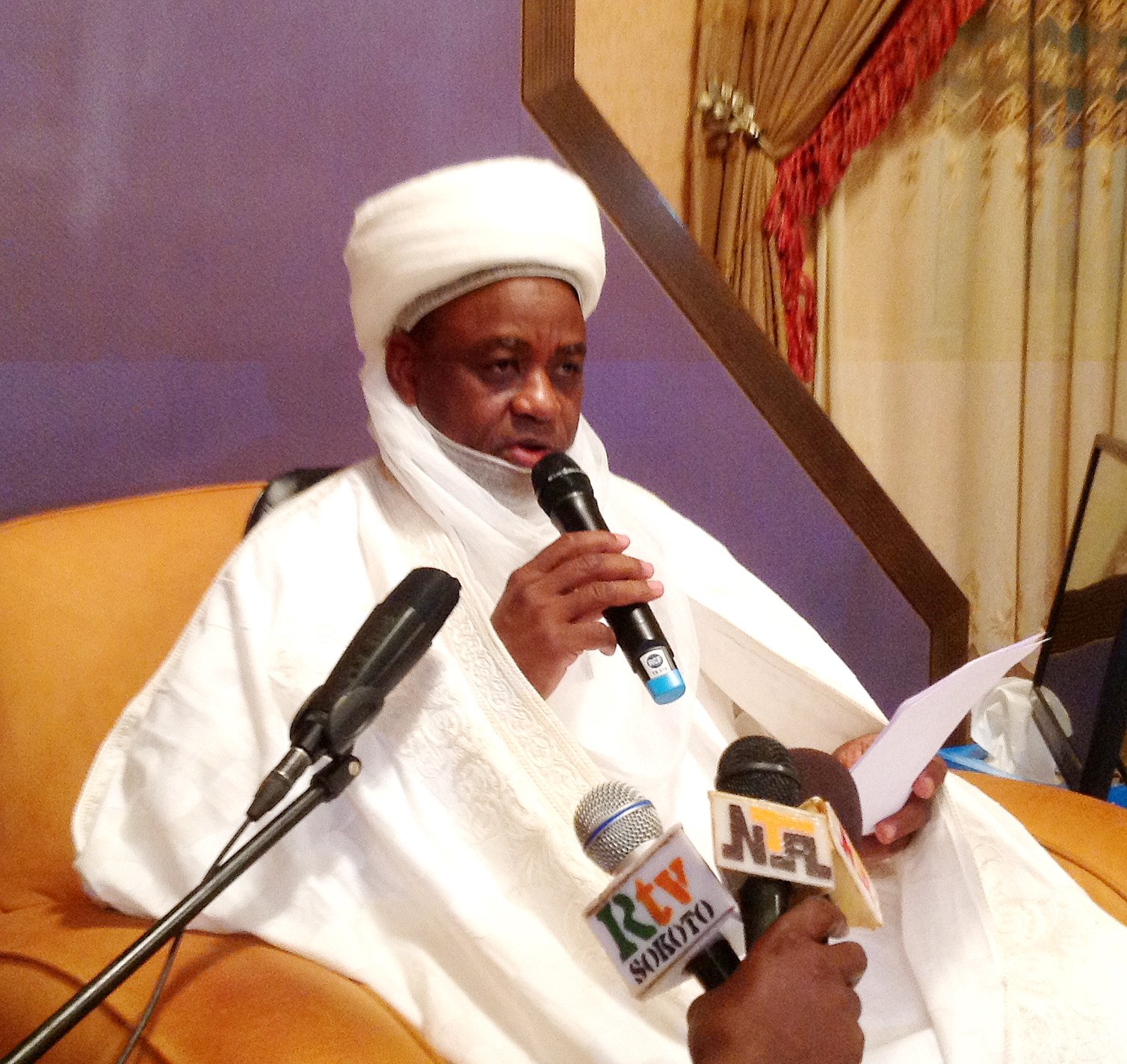
The President-General of NSCIA, the Sultan of Sokoto, His eminence, Alhaji Muhammad Sa’ad Abubakar III

The NSCIA is saddled with the responsibility of superintending the affairs of Islam and Muslims in Nigeria, equally wants the Federal Government to hands off its sponsorship of pilgrims, added that if given the opportunity to manage hajj affairs, intending pilgrims would pay lower than the over N1 million being demanded for this year’s hajj.


Stating how the 2017 Hajj fare was arrived at, Muhammed explained further that, it was not NAHCON that sat down to arrive at the cost of Hajj fare, he said, “so many agencies were involved, like NCAA as regulatory body, FAAN with all other aviation agencies, ICPC, EFCC, Nigerian Police, the representatives of the States Pilgrim Welfare Board from their respective Executive Secretaries, six geopolitical commissioners, fulltime Commissioners from the Board and so many relevant agencies participated in the activity of Hajj fare.


He added that, “this wide range of participation did sit down for days to ascertain the type of machines, the performance, the document, capability, the price charges and all other technicalities involved in the Hajj operation. While NCAA also goes back to break it down component by component to arrive at a cost per pilgrim, then they (NCAA) put out the fare and advise.” Muhammed maintained that the Commission does not blindly set fares for pilgrims, Hajj fare is being set by this wide-range committee.


According to him, “After all these, the Commission then writes to the Federal Government  to seek approval and government also looked into it component by component before it finally gives approval on what to charge for airlift per pilgrim.”


NAHCON boss however charged Journalists to always verify their stories before rushing to press, so that Journalists do not cause any injury upon any personality, certain organisation and even individuals. “Particularly you Journalists, please try to verify anything that comes your ways, so as to avoid injury on personality or organisations.”


He hinted the Journalists on the report of the 2015 Hajj stampede victims, where about 300 Nigerian Pilgrims died, he said up till now about five people that are reported missing, having sent the DNA of their first relations to the Kingdom, said that the Commission is yet to receive any report from the Kingdom of Saudi Arabia. Stated further that in order to forestall such occurrence, NAHCON took blood samples of all intending Pilgrims and kept in the blood bank in the event of such occurrence. God forbid, he prayed.


On the issue of compensation for the pilgrims who died during the ugly incident, he said no compensation has been released to the Commission, he however assured the relatives of the deceased persons that any moment it released, and the Commission would not hesitate to hand it over to the relations of the crane-crash victims.


On the Commission’s progress reports, the Chairman of the Commission also said that NAHCON has developed a Software Management System, According to him, “The Commission immediately after the 2016 Hajj visited some Hajj Commissions to compare the commission’s operation, progress, challenges and issues. We realised that most of them do conduct most of their activities online, we decided to contact our sister country, Pakistan which agreed to assist NAHCON with software at no cost.


“A team from Pakistan came here in Nigeria spent barely 10 days, we want the software system to take effect this year but we are still discussing so that we don’t leave any component of Hajj operation behind. Very soon everything about Hajj operation will be done online, even up to accommodation processing, where Pilgrims open up accommodation process to select the hotel, check the facilities, contact the owner and see the list, negotiate the price and make payment while Pilgrims are here in Nigeria before leaving for the Kingdom.” He said.


For Tour Operators, Muhammed said, the Commission has set standards for the Tour Operators, he pointed out, apart from the traveling agencies prequalified by the Commission there are some illegal ones. “The Commission is making frantic efforts this time around through the Committee of Inspectorate Services of the Commission, where some of their offices in Lagos, Kano and Abuja were closed down.” Added that the Commission enjoys the optimum support of the security agents so as to ensure standards in Hajj Operation and improve on the image on the country in the Holy land.


Muhammed maintained that it is the activities of the illegal Tour Operators that dislocate the arrangement of the Commission at the Holy land.


On the Commission’s permanent office accommodation, he said the Commission is making spirited efforts through AMCON to acquire a befitting property for the Commission. The Commission hinted Journalists on its readiness to set up Hajj Savings Scheme where Pilgrims softly making payments over a period of time to enable them perform Hajj at the scheduled time.


The Chairman of the Commission also made known of the intention of his Commission to establish Training Institute for Hajj Managers, in view of non-existence of professional training for Hajj Managers in Nigeria. He added that the development will be in collaboration with local and foreign institutions.


“The proposed institute will serve as a professional training centre for all Hajj Managers in Nigeria and neighbouring African countries.  He concluded.

   

About author
Time Nigeria is a modern and general interest Magazine with its Headquarters in Abuja. The Magazine has a remarkable difference in editorial philosophy and goals, it adheres strictly to the ethics of Journalism by using the finest ethos of the profession to promote peace among citizens; identifying and harnessing the nation’s vast resources; celebrating achievements of government agencies, individuals, groups and corporate organizations and above all, repositioning Nigeria for the needed growth and development. Time Nigeria gives emphasis to places and issues that have not been given adequate attention by others. The Magazine is national in outlook and is currently being read and patronized both in print and on our vibrant and active online platform (www.timenigeria.com).
Articles
Related posts
All The NewsCover StoryNewsPolitics

Musa Tsoken Congratulates Kalu on Daily Times’ Lawmaker of the Year Award

1 Mins read
The National Coordinator of the Asiwaju Again Renewed Hope Support Initiative 2027 and National President of the APC Initiative for Good Governance…
Abuja FileDevelopmentEconomyEnergyFinanceInside LagosOpinionPerspective

The Missing Middle of Infrastructure Finance: Why Capital Still Fails to Become Infrastructure

6 Mins read
  By Chidi Nwafor  In October 2023, a Gulf sovereign wealth fund quietly closed a $2 billion allocation to global infrastructure, earmarked in part for emerging-market energy and transport assets. The announcement drew the usual applause: another sign, commentators said, that institutional capital was finally waking up to the infrastructure opportunity in the Global South. Eighteen months later, less than a tenth of that allocation had actually left the fund’s balance sheet. Not because the mandate had changed. Not because the fund had lost appetite. According to two people familiar with the portfolio, the constraint was simpler and more uncomfortable: there were not enough investable projects to put the money into. This is not a story about a reluctant investor. It is a story about capital that wants to move, cannot find enough places willing and able to receive it in a form it can underwrite, and quietly waits instead. Multiply that fund by the hundreds of pension schemes, sovereign wealth vehicles, commercial banks and infrastructure funds now carrying dedicated allocations for emerging-market infrastructure, and a pattern emerges that rarely makes it into a headline: the world is not short of capital for infrastructure. It has capital in historic abundance, sitting adjacent to a historic infrastructure gap, unable to cross the distance between the two. The Comfortable Explanation  The explanation on offer at every major infrastructure summit is a familiar one. Global infrastructure investment needs run into the tens of trillions of dollars over the coming decade; committed capital falls well short; therefore, the problem is one of insufficient funding, and the solution is more of it: more pledges, more blended-finance facilities, more climate funds, more multilateral capital increases. It is a comfortable explanation because it assigns responsibility clearly to governments who under-fund, institutions who under-commit, and it offers a clean remedy: raise more. It is also, on close inspection, not what the evidence shows. Pension funds globally hold trillions in assets under management with explicit infrastructure allocations that remain structurally underweight, not because trustees have rejected the asset class but because deal flow meeting their risk and governance thresholds has not materialised at the pace their mandates assume. Sovereign wealth funds report the same pattern. Commercial banks with dedicated project finance desks describe pipelines that look full at the term-sheet stage and thin dramatically by financial close. Development finance institutions, whose entire purpose is to absorb risk that commercial capital will not, routinely report that their binding constraint is not capital adequacy but the volume of bankable transactions their teams can originate and structure in a given year. None of this fits the scarcity narrative. All of it fits a different one. Availability Is Not Deployability  Capital availability and capital deployability are not the same condition, and the conflation of the two is doing real damage to how the world thinks about the infrastructure gap. Availability asks whether money exists somewhere with a mandate that could, in principle, be pointed at infrastructure. Deployability asks something much narrower and much harder: whether a specific project, at a specific moment, has been engineered, structured, documented and de-risked to the point where an investment committee can approve it without exception. The first condition is met, overwhelmingly, across nearly every category of capital that matters to infrastructure. The second is met by only a small fraction of the projects competing for it. The result is a market that looks, from the outside, like a financing gap, and functions, from the inside, like a conversion problem: an abundance of capital on one side, an abundance of infrastructure need on the other, and an underbuilt set of mechanisms in between capable of turning one into the other at any meaningful scale. Where the Conversion Breaks  The break does not happen at the ends of the process. It happens in the middle, in the unglamorous sequence of work that turns a plausible concept into an instrument a fiduciary can sign. A promising transmission project needs a feasibility study rigorous enough to survive institutional scrutiny rather than optimistic enough to attract early interest. It needs offtake arrangements that hold up under real counterparty and currency risk, not the counterparty risk assumed in a base case. It needs environmental and social documentation calibrated to the standards of the institutions being asked to fund it, not the standards of the jurisdiction hosting it. It needs a legal and commercial structure that allocates risk in ways a commercial lender, not only a development financier, will accept. It needs a sponsor capable of executing what has been proposed, not merely capable of proposing it. Each of these is ordinary project finance discipline. None of it is exotic, and in mature infrastructure markets it happens as a matter of course, absorbed into systems built over decades: specialist advisers, standard-form contracts, established procurement norms, deep pools of transaction expertise. What is missing in the markets where the infrastructure gap is largest is not the standard itself but the machinery that meets it. Projects arrive at investment committees with ambition intact and preparation incomplete, and that gap is treated, again and again, as an individual project’s failure rather than what it actually is: a structural absence in the systems responsible for producing investable transactions at scale. The Missing Middle  This is the Missing Middle of Infrastructure Finance: the institutional architecture that sits between capital that wants to move and infrastructure that needs building, and whose incompleteness explains far more of the global infrastructure gap than any shortfall in committed funds. It consists of project preparation facilities able to fund feasibility and structuring work before commercial viability has been proven. Transaction advisers capable of building deals that satisfy development mandates and commercial return thresholds at once, rather than treating the two as separate constituencies to be managed sequentially. Risk-sharing and guarantee instruments that convert political, regulatory and currency risk into something a commercial balance sheet can underwrite. Aggregation platforms that bundle smaller, individually sub-scale projects into portfolios large enough to justify institutional transaction costs. Standardised documentation that reduces the bespoke legal cost of every new deal. And coordination across ministries, regulators and financiers robust enough that a technically sound project does not die in bureaucratic sequencing after the money has already been found. None of these are new ideas in isolation. What is missing is their assembly into a coherent system, deliberately funded and institutionally accountable, rather than scattered across donor-funded pilots that end when the grant does. The African Dimension  Africa makes this dynamic unusually visible, and consequently offers an unusually clear opportunity to correct it. The continent’s infrastructure financing need, by any measure, is vast. Less understood is that the shortfall is disproportionately one of preparation rather than capital. Nigerian gas-to-power, off-grid solar and mini-grid developers have each demonstrated that individual projects can clear the bankability bar; what has not emerged is systemic pipeline scale, a steady stream of comparably prepared projects large enough to absorb the capital already circling the sector. The pattern repeats, with local variation, from grid infrastructure in East Africa to transport corridors in West Africa. Interested capital is rarely the scarce input. Investment-ready projects are. The Global Comparison  Mature markets solved this problem gradually and mostly invisibly, through decades of institution-building that predates the current infrastructure conversation: specialist project finance units inside banks, standardised PPP frameworks, established regulatory playbooks, deep benches of transaction lawyers and engineers who move between deals rather than between one-off assignments. Emerging and frontier markets are not being asked to meet a lower standard. They are being asked to meet the same standard without having built the same machinery, and then being told, when deals fail to close, that the problem is insufficient funding….
Cover StoryNewsSports

Union Bank, AIICO Multishield, Checkers Custard, Others Back 5th Cycling Lagos

2 Mins read
Union Bank of Nigeria Plc, AIICO Multishield, Checkers Custard and other corporate organisations have thrown their weight behind the 5th Cycling Lagos,…
Stay on the loop!

Subscribe to our latest news.

Leave a Reply

WP2Social Auto Publish Powered By : XYZScripts.com